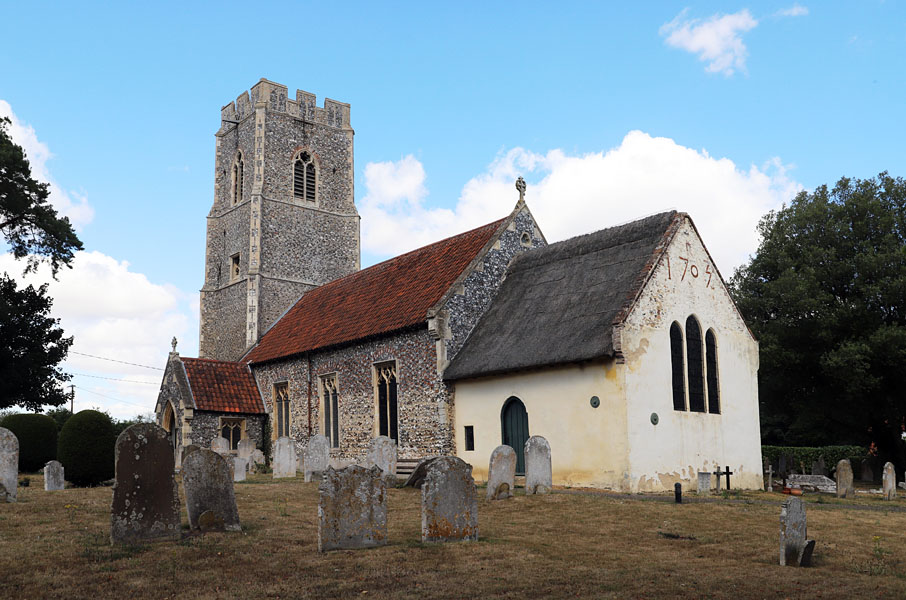
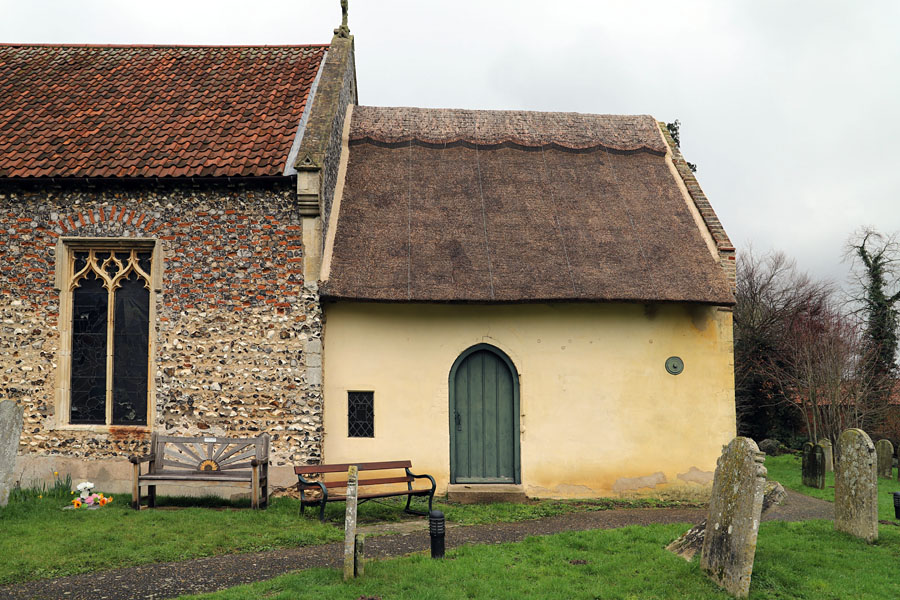
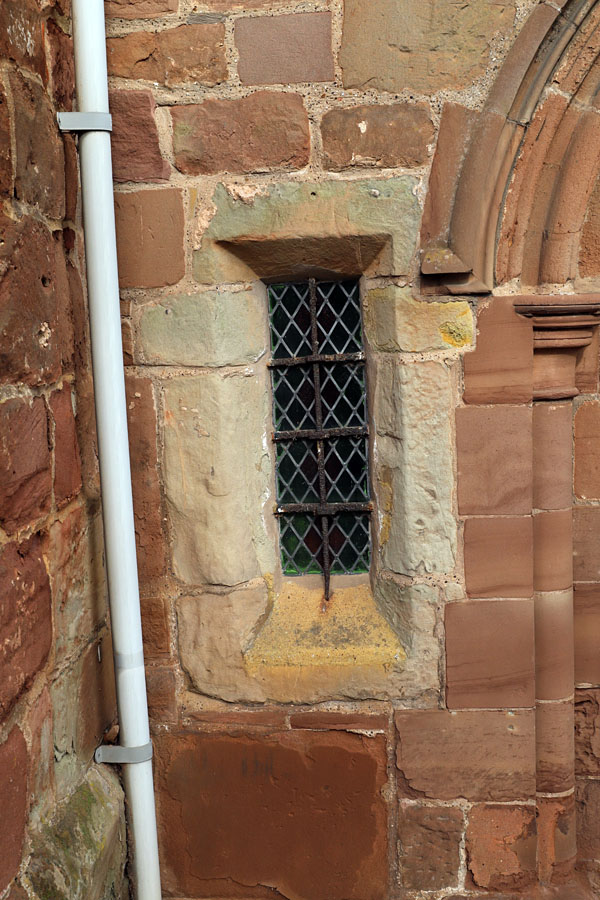
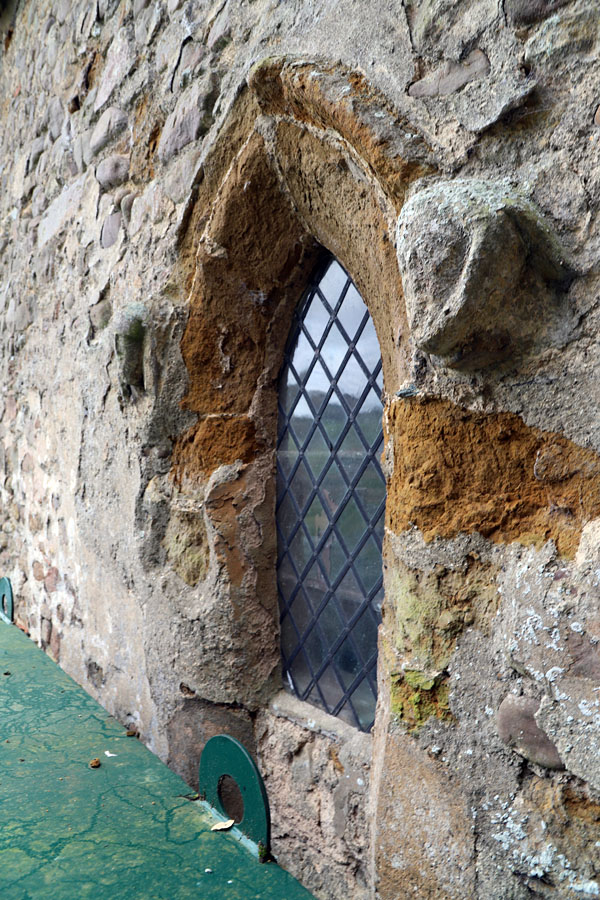
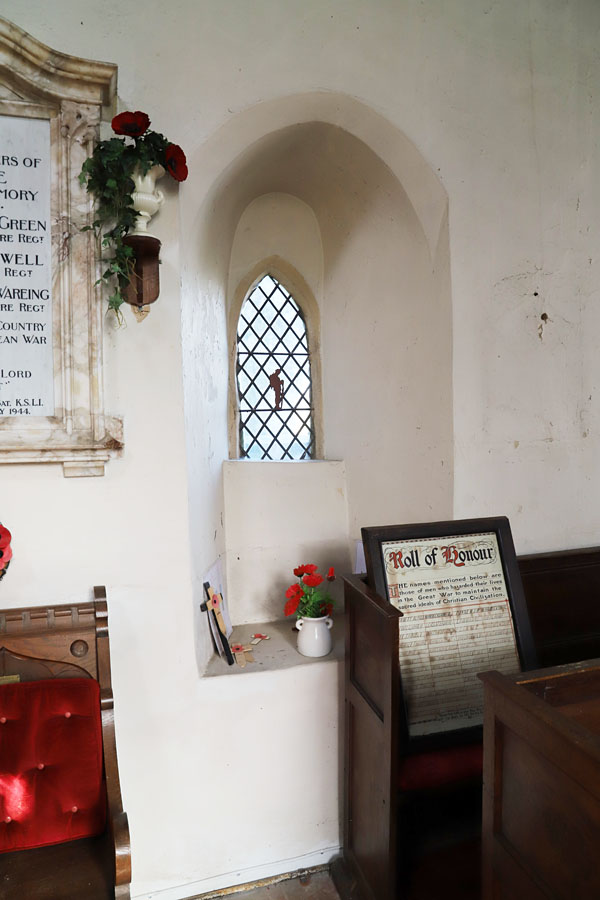
All Saints has a curiously small chancel. A pair of lancets in the north wall suggest it was originally built in the c12 or early c13. At some point in history the walls were rendered and painted, though originally it is likely the flintwork was exposed as it is in the nave. It still retains its thatched roof. Drastic repairs to the east gable were carried out in 1703, the date being marked in brick. On the south side the only openings are a priest's door and a small rectangular low side window, deeply splayed internally. The lower hinge for a shutter is still visible on the internal jamb.
All Saints, Horsford, Norfolk. South wall of chancel with low side window.
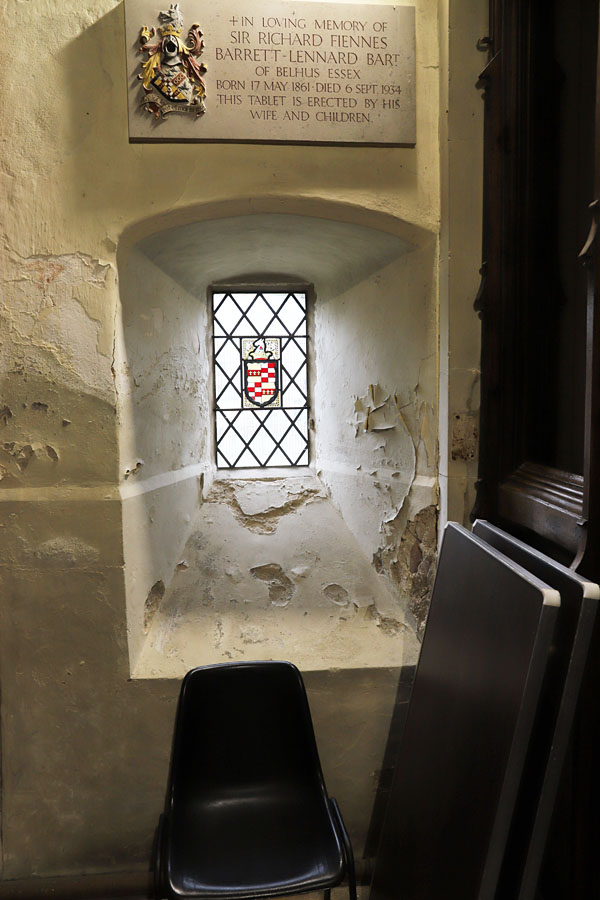
All Saints, Horsford, Norfolk. Internal view. The lower hinge for a wooden shutter can still be seen on the right jamb.
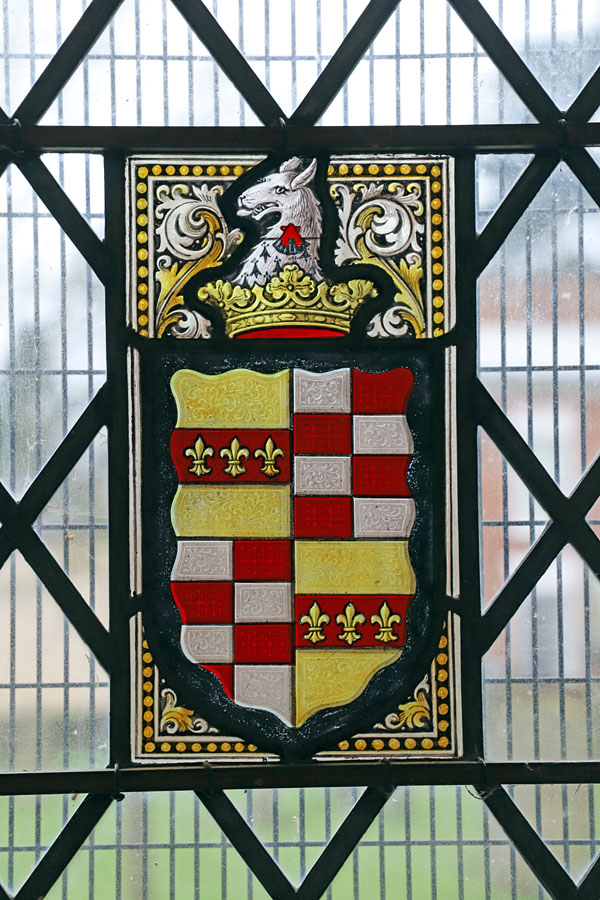
All Saints, Horsford, Norfolk. Internal view. The window has 20th century glass with the arms of Sir Richard Fiennes Barrett-Leonard (d 1934) to whom the window is dedicated.
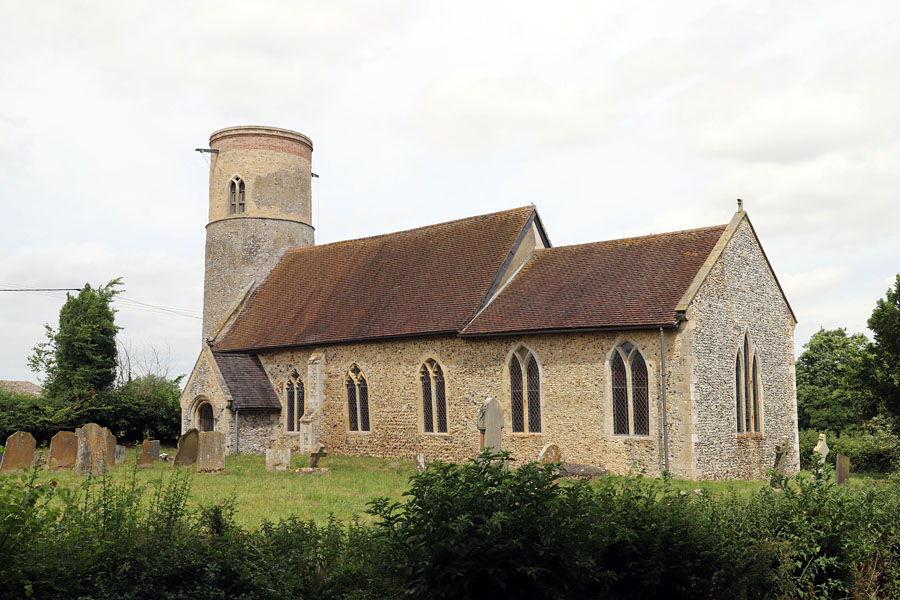
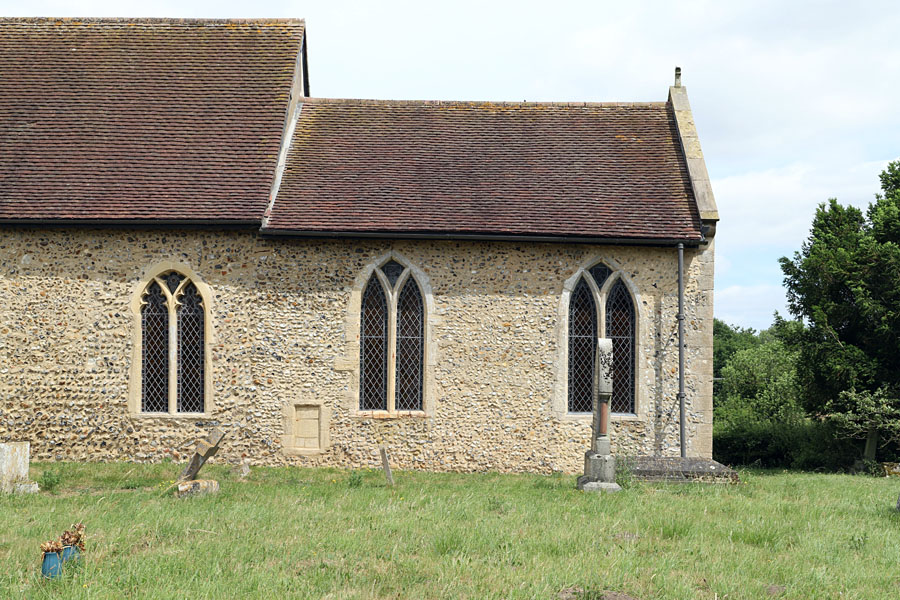
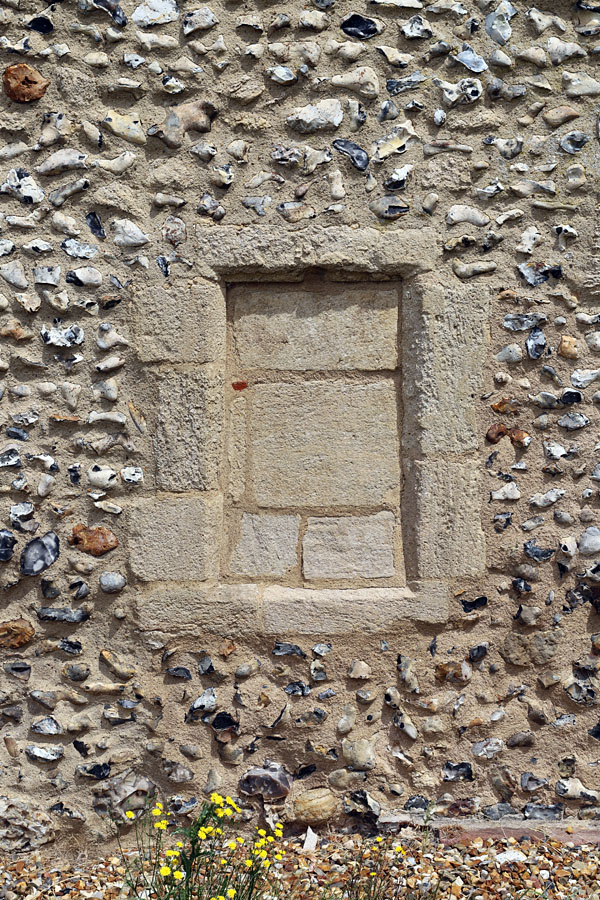
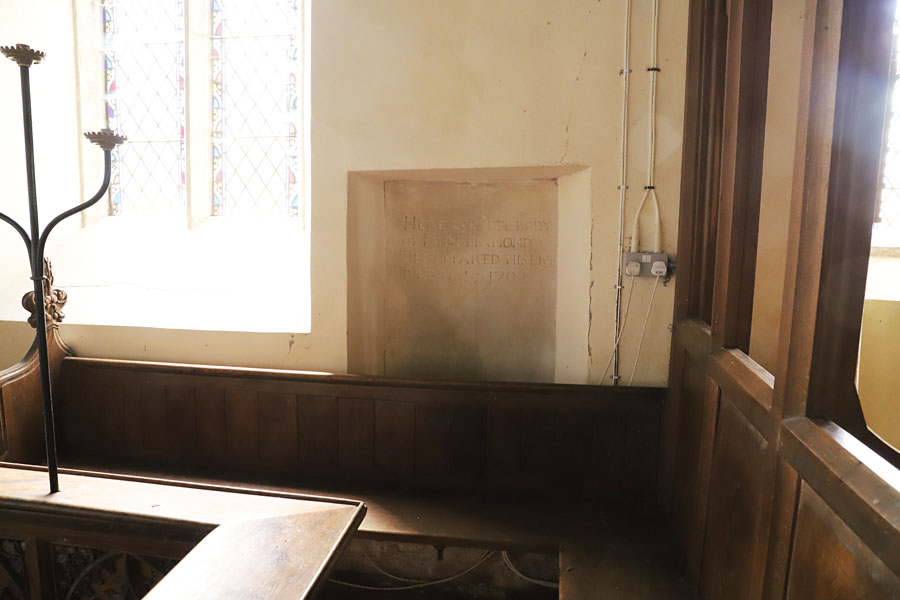
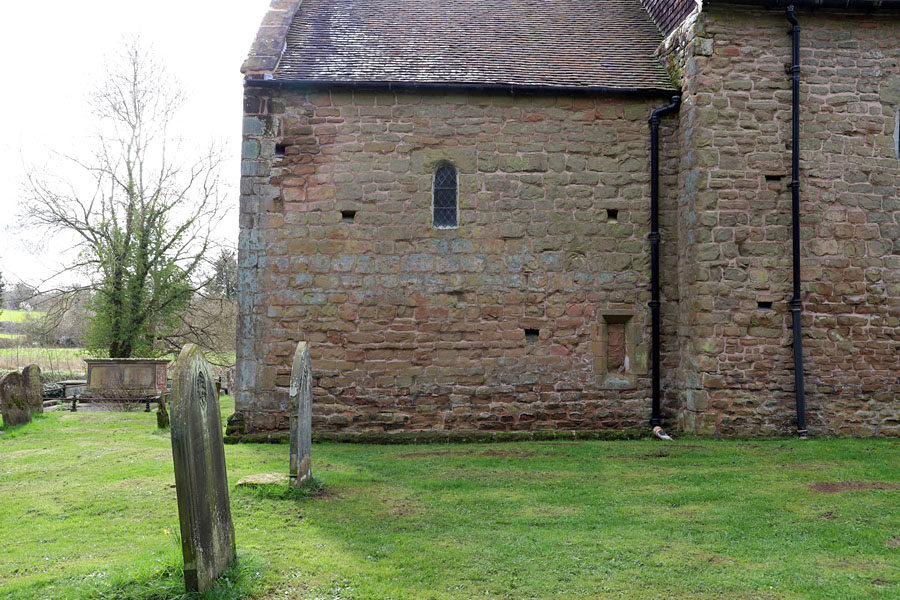
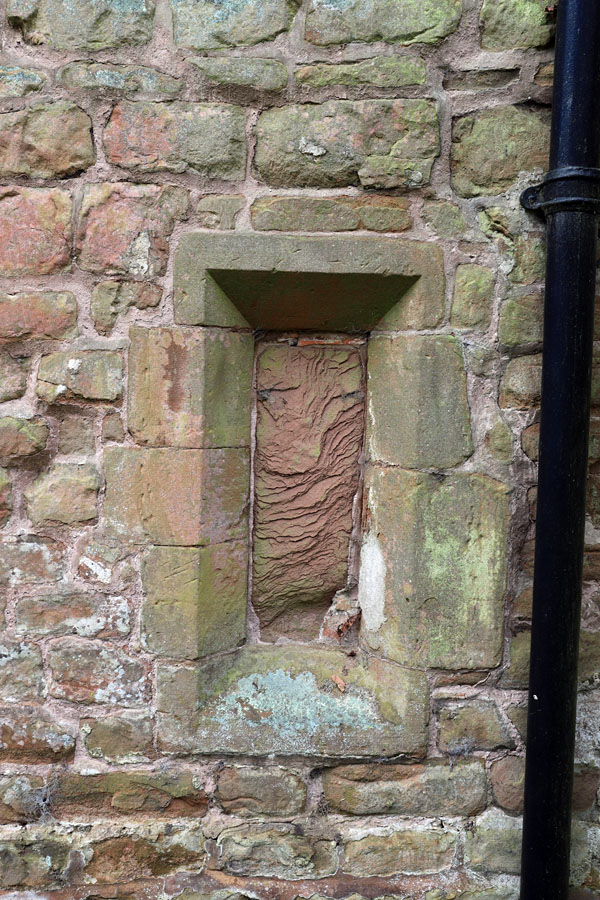
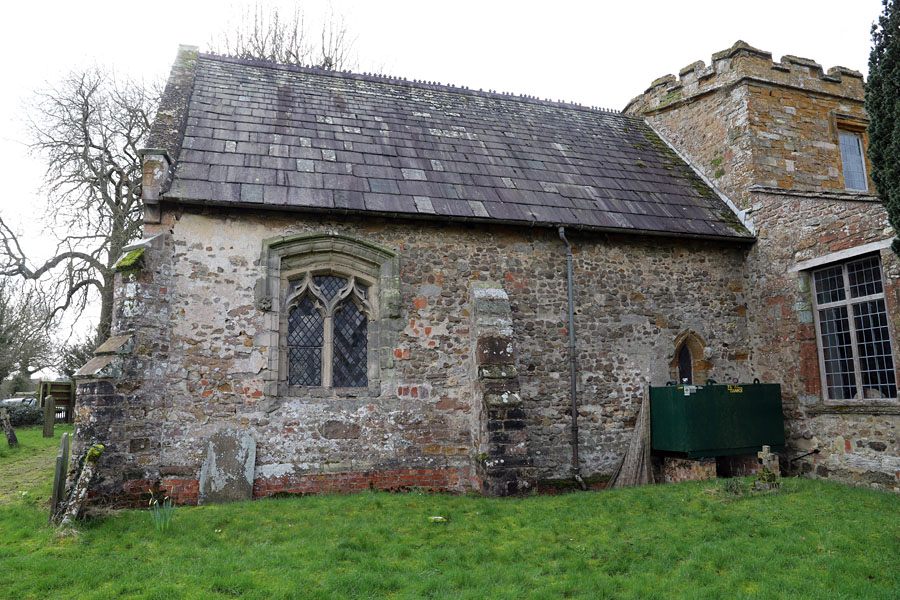
All saints is late c13 or early c14. It is thought likely that the round tower was part of the initial build, though the upper stage is modern. In the south chancel wall are two large Y-tracery two-light windows, but the westernmost is a little too high and to far east to function as a confessional window. There are no windows on the north side of the chancel. The rectangular opening, now blocked, near the west end of the chancel is clearly a later addition. The jambs, lintel and sill are of well dressed stone. Internally there is a slight splay. A dedication carved into the render reads: "Here lyeth the body of John Hamond who departed this life June 15 1702".
All Saints, Threxton, Norfolk. South wall of chancel with low side window.
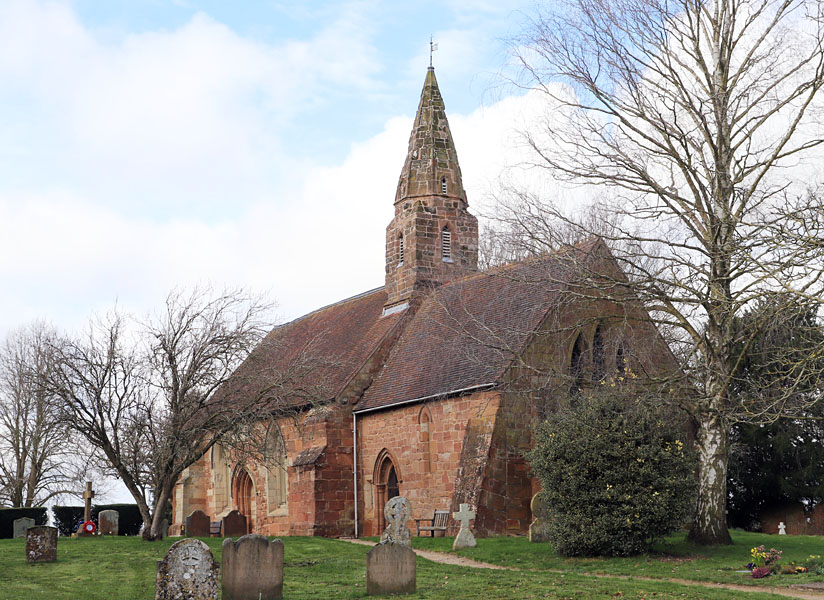
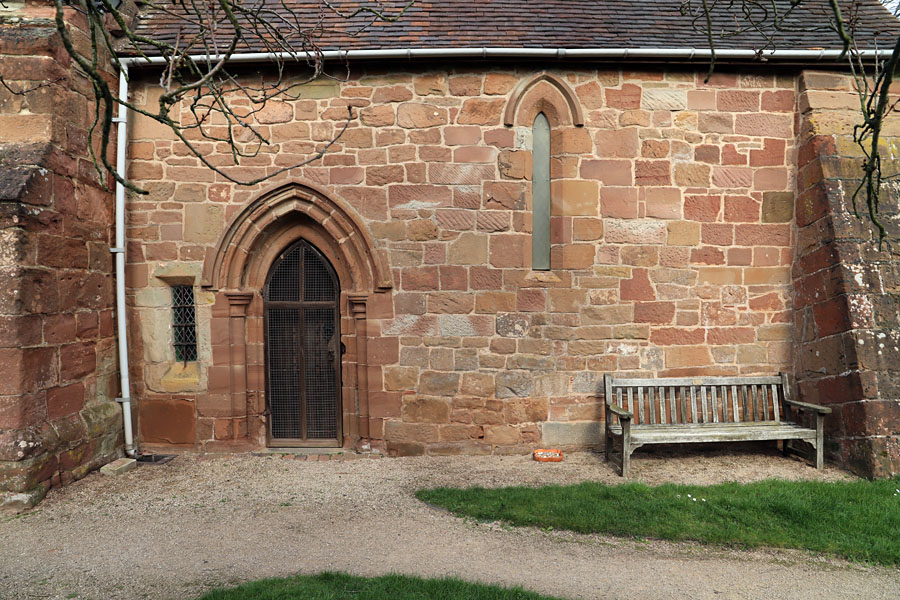
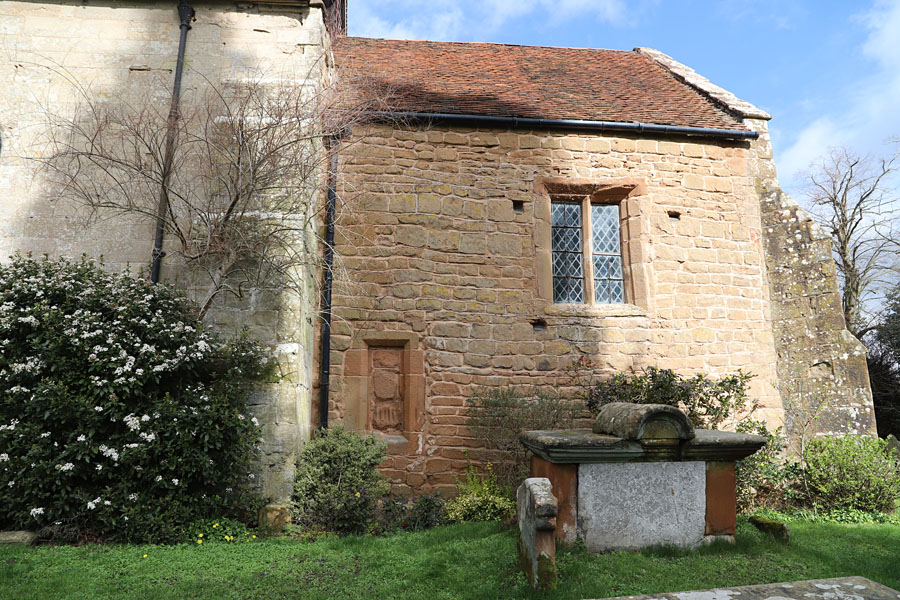
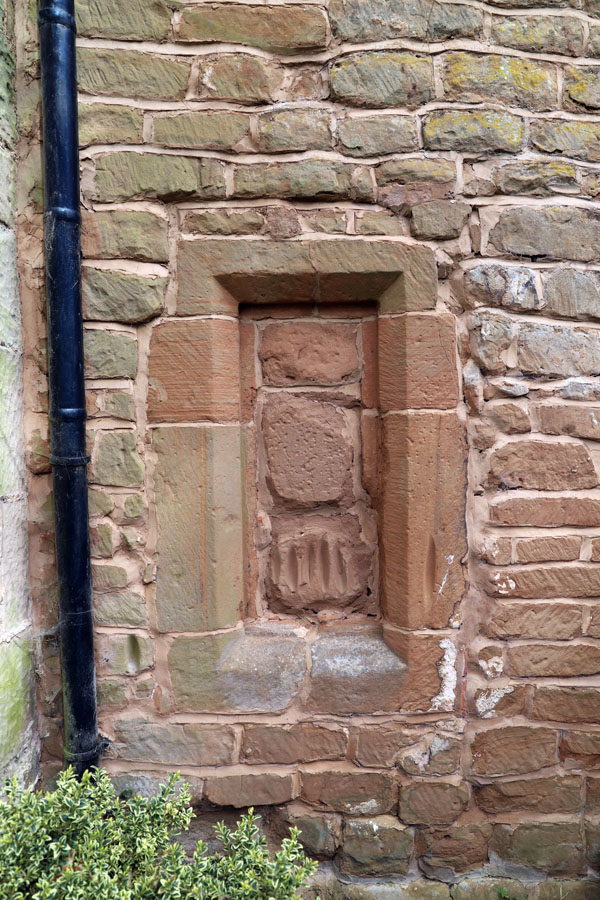
St John the Baptist is a curious church, it having a stone bell-tower over the junction of the chancel and nave. In order to support this tower a second chancel arch has been built, and the north and south walls of the tower extended down to floor level. This creates a sort of passageway between the nave and chancel. The church also has a very unusual double north aisle. The chancel is c13. On the south side is a tall, narrow lancet place d roughly centrally, and a priest's door. The low side window is unremarkable, rectangular in shape, and shoe-horned in the narrow space between the priest's door and the massive buttress which helps support the bell tower. The iron bars are still in place, and could be original. Houghton notes the rough construction of the low side window in marked contrast to the elegant hood-mould, and nook shafts of the priest's door.1
Houghton, F. T. S. Low Side Windows in Warwickshire Churches. Trans. Birmingham Arch. Soc. 1906.
St John the Baptist, Baginton, Warwickshire. South wall of chancel with low side window. The window was clearly constructed some time after the chancel was built, and no attempt has been made to match the stonework. Houghton noted the marked contrast between the finely constructed priest's door and the low side window, but stopped short of suggesting that the latter was installed in haste.
St John the Baptist, Baginton, Warwickshire. Detail view.
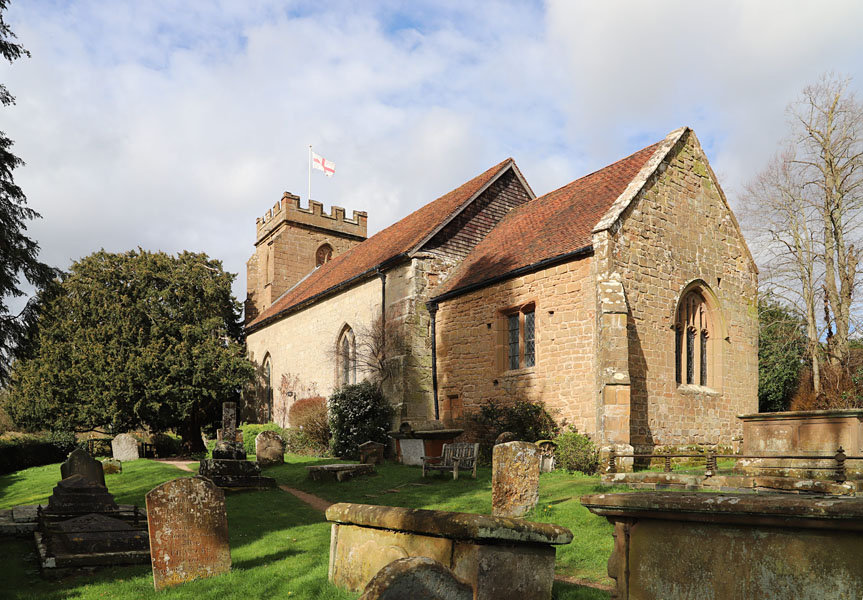
The church is Saxon/Norman in origin, still having its small round-headed lancets high in the north chancel and north nave walls, all with massive single head stones. There are two low side windows in the usual place, both are rectangular, and of similar size and construction. Both are blocked. All evidence of their character internally has been obliterated by render and whitewash. In the south wall of the chancel there is a square two-light window of later c14 or c15 date, also high up. It may have replaced a window similar to that in the north wall. Neither of the low side windows retains evidence of hinges.
Assumption of Our Lady, Ashow, Warwickshire. South wall of chancel with low side window.
Assumption of Our Lady, Ashow, Warwickshire. South LSW detail view.
Assumption of Our Lady, Ashow, Warwickshire. North wall of chancel with low side window.
Assumption of Our Lady, Ashow, Warwickshire. North LSW detail view.
The low side windows at All Saints, Lilbourne, could be allocated to two categories. The south west chancel c14 two-light window is low enough, and in the correct location to have been modified for a confessional window, so therefore qualifies to be in category D. Both lights are partially blocked. However, the chancel floor is lower than the outside ground, the latter probably being raised over the centuries as a result of burials, and therefore, internally, it makes it a little high for the confessor. On the north side is a small lancet, partially blocked, which would more appropriately serve as a confessional window. This window also has a low seat. This north side window would properly belong to category A. The chancel was built in the late c12, likely replacing an earlier Saxon structure. In the fields to the east of the church is Lilbourne Castle, a Norman Motte and Bailey, likely built not long after the conquest. Much of the chancel has been replaced and the two-light windows under shallow arched heads we see today are certainly c14 or later.
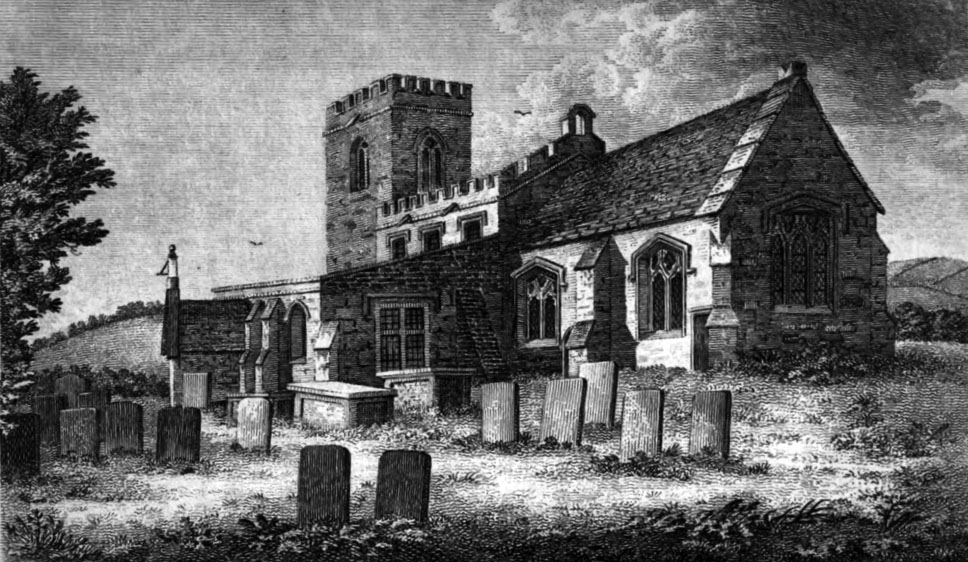
The engraving left was published in the Gentleman's Magazine in January 1800, and is possibly from c1750. This shows a Sanctus bell cote on the east gable of the nave. The north window is discussed on the next slide.
All Saints, Lilbourne, Northamptonshire.
General view of the chancel north side. The low lancet now partially blocked with stone and cement (and partially obscured by the oil tank) probably dates from c13. But, if a window was installed here as part of the original c12 build why was it positioned so low? It is possible that the north wall originally had no windows at all, and that the lancet was installed in the mid c14? The eastern window is late c14 or later, indicating that wholesale changes have been made over the centuries. The lancet certainly qualifies as an independent low side window. Internally it has a wide splay and a seat about 50cm above the chancel floor.
The Sanctus bell cote is now gone. The bell itself was removed in the 1800s, and the cote in the 1990s when the roof was repaired.1
Notes in the church.
All Saints, Lilbourne, Northamptonshire. External view of the north low side window.
All Saints, Lilbourne, Northamptonshire. Internal view of the north low side window.
All Saints, Threxton, Norfolk.
All saints is late c13 or early c14. It is thought likely that the round tower was part of the initial build, though the upper stage is modern. In the south chancel wall are two large Y-tracery two-light windows, but the westernmost is a little too high and to far east to function as a confessional window. There are no windows on the north side of the chancel. The rectangular opening, now blocked, near the west end of the chancel is clearly a later addition. The jambs, lintel and sill are of well dressed stone. Internally there is a slight splay. A dedication carved into the render reads: "Here lyeth the body of John Hamond who departed this life June 15 1702".
All Saints, Threxton, Norfolk. South wall of chancel with low side window.
All Saints, Threxton, Norfolk. External view.
All Saints, Threxton, Norfolk. Internal view.
St John the Baptist, Baginton, Warwickshire.
St John the Baptist is a curious church, it having a stone bell-tower over the junction of the chancel and nave. In order to support this tower a second chancel arch has been built, and the north and south walls of the tower extended down to floor level. This creates a sort of passageway between the nave and chancel. The church also has a very unusual double north aisle. The chancel is c13. On the south side is a tall, narrow lancet place d roughly centrally, and a priest's door. The low side window is unremarkable, rectangular in shape, and shoe-horned in the narrow space between the priest's door and the massive buttress which helps support the bell tower. The iron bars are still in place, and could be original. Houghton notes the rough construction of the low side window in marked contrast to the elegant hood-mould, and nook shafts of the priest's door.1
Houghton, F. T. S. Low Side Windows in Warwickshire Churches. Trans. Birmingham Arch. Soc. 1906.
St John the Baptist, Baginton, Warwickshire. South wall of chancel with low side window. The window was clearly constructed some time after the chancel was built, and no attempt has been made to match the stonework. Houghton noted the marked contrast between the finely constructed priest's door and the low side window, but stopped short of suggesting that the latter was installed in haste.
St John the Baptist, Baginton, Warwickshire. Detail view.
Assumption of Our Lady, Ashow, Warwickshire.
The church is Saxon/Norman in origin, still having its small round-headed lancets high in the north chancel and north nave walls, all with massive single head stones. There are two low side windows in the usual place, both are rectangular, and of similar size and construction. Both are blocked. All evidence of their character internally has been obliterated by render and whitewash. In the south wall of the chancel there is a square two-light window of later c14 or c15 date, also high up. It may have replaced a window similar to that in the north wall. Neither of the low side windows retains evidence of hinges.
Assumption of Our Lady, Ashow, Warwickshire. South wall of chancel with low side window.
Assumption of Our Lady, Ashow, Warwickshire. South LSW detail view.
Assumption of Our Lady, Ashow, Warwickshire. North wall of chancel with low side window.
Assumption of Our Lady, Ashow, Warwickshire. North LSW detail view.