
The Medieval Church’s Attitude to Leprosy
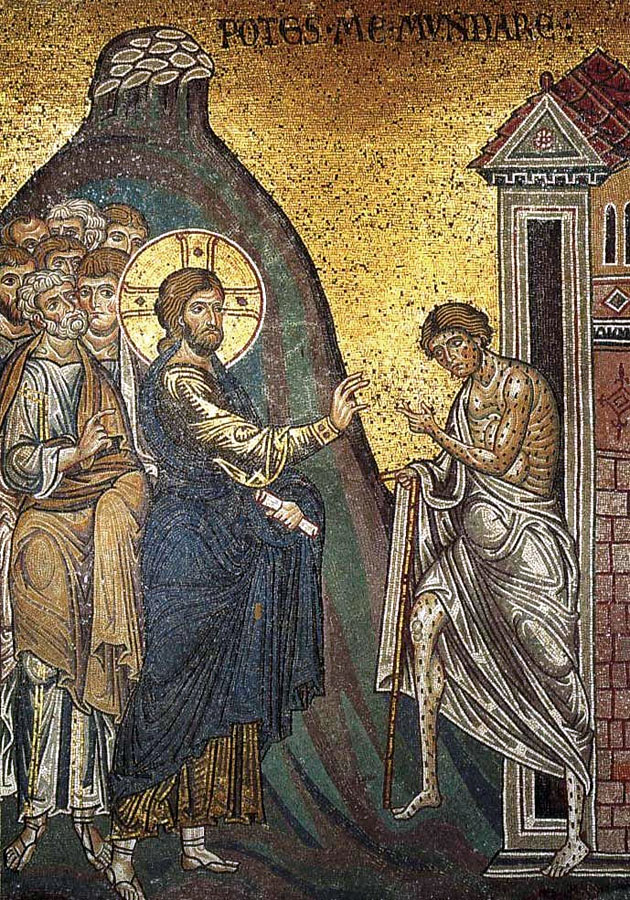
Jesus Healing the Leper. Icon in the Cathedral of Santa Maria,
Florence. PD Image.
PD Image

The theory that LSWs were installed to permit lepers to witness the Elevation of the Host, or to give confession without entering the church, looms large in popular imagination, and being somewhat sensationalist has been hard to dislodge over the years. Indeed, there are plenty of examples of modern church guides describing LSWs as “leper windows” (e.g. Offchurch, Warwickshire, Doynton, Gloucestershire to name but two). At St Andrew’s, Buckland, Hertfordshire, a blocked up LSW was discovered during a restoration in 1854, and was reinstated. The opening was glazed with stained glass depicting Jesus healing the leper, which W. B. Gerish described as “regrettable”, as it, “.. perpetuates the erroneous theory of the lepers using the window to witness Mass”.1 At nearby St Mary’s, Braughing, Hertfordshire, a low side window was uncovered during the 1888 restoration and it is now also glazed with a window depicting a similar scene.2 The low side window at St Catherine's Church, Flempton, Suffolk is similarly glazed with a scene depicting the cleansing of a leper. Of the last three theories to have been described above, this one is the easiest to dismiss as mere folklore.


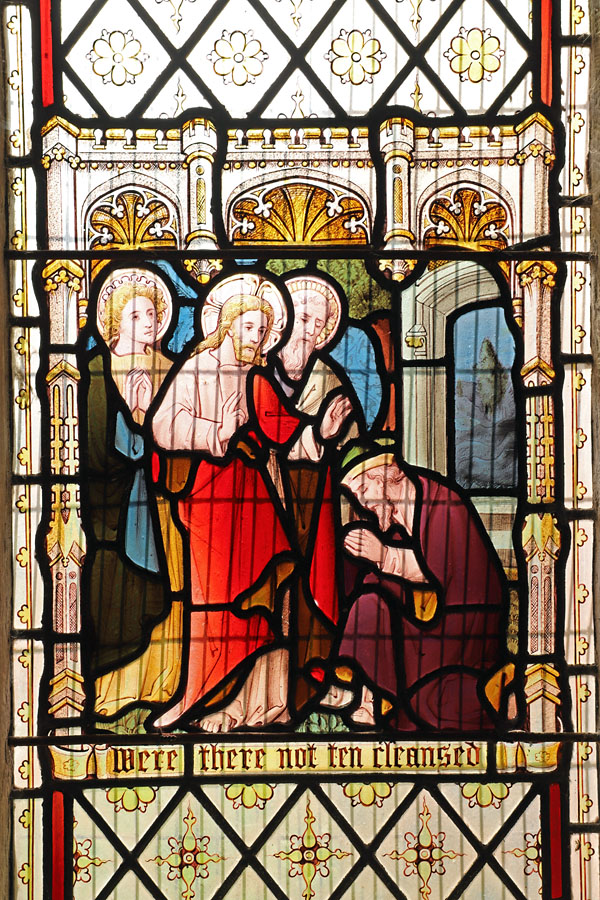
The notion of a LSW being a leper confessional may have arisen as a result of a discovery of a fresco in the chapel of Eton College. The Rev J. Charles Cox described the painting thus:3
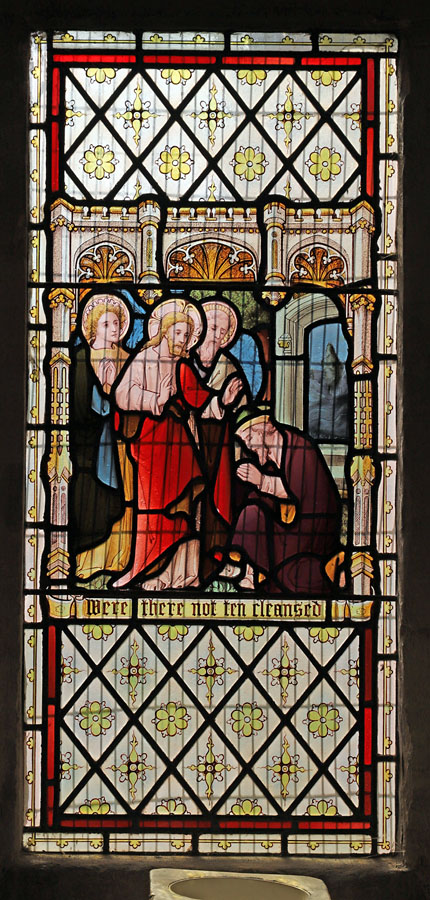
The low side window at St Mary's,
Braughing, Hertfordshire with a depiction
of Jesus Healing a Leper.
As has already been noted, lepers were not permitted to enter a churchyard, let alone the body of the church, and were discouraged from even entering a village lest they pass on the scourge. They were considered by the church as already dead, and read the last rites despite the fact that they might live for many years. However, Christian charity extended to those who were afflicted, and they were provided with “hospitals” or “Lazar Houses” for their care. These institutions were usually equipped with a consecrated chapel where the Elevation of the Host could be observed and confession given, making the installation of a LSW in the parish church for such a purpose unnecessary. Many hospitals had a significant staff of clerics, clerks, and cleaners, and they were widely distributed. Newman lists 194 hospitals across England and Wales, 17 in Scotland, and 22 in Ireland all of which were founded between the 11th and 16th century (with one at St Kilda, Scotland established as late as 1648).4 A greater part of these were founded in the 13th and 14th centuries, and many were small, catering for little more than a dozen inmates, some fewer still. It is clear from these numbers and the wide distribution of hospitals that good provision was made for those suffering with the disease, both for their corporal and spiritual needs, though generally hospitals were not primarily set up for the former, but rather to isolate lepers from the otherwise “healthy” population. It would also suggest that as a proportion of the entire population, lepers were few. It would be well known in the 13th century that leprosy was not particularly contagious, as can be witnessed by healthy carers mixing with lepers in the hospitals. For these two reasons alone, going to the great trouble of installing a large number of LSWs in parish churches would be a wasteful exigency. However, there may be examples of churches said to have been endowed with LSWs precisely to serve lepers. In the west porch of St Mary’s, Melton Mowbray, Leicestershire, there are a number of opening which could be described as "low". Although not in the normal location, these have long been described as being confessional windows provided for the use of lepers travelling to the nearby hospital of Burton Lazars (founded 1157), one of the largest in the country.5 The use of LSWs for general confession is dealt with below. As for witnessing the Mass, most low side windows do not afford a view of the altar, and, as noted above, even if the altar was visible, and given that many LSWs are relatively small, the view would only have been available to a single individual at a time. The windows at Melton Mowbray are far away from the altar, and the same objection applies. The distribution and number of LSWs in England would suggest that leprosy was widespread and of epidemic proportion. Although a terrible disease, this was not so, (Newman’s numbers confirm this) and lepers would naturally congregate in the hospitals provided for their better care, rather than be seen roaming the countryside. If any further argument is required, it may be mentioned that the 23rd canon of Pope Alexander III issued at the Third Lateran Council in 1179, decried the lack of Christian mercy towards lepers, “who cannot dwell with the healthy or come to church with others, to have their own churches and cemeteries or to be helped by the ministry of their own priests.”, and set about the task of providing for their needs;
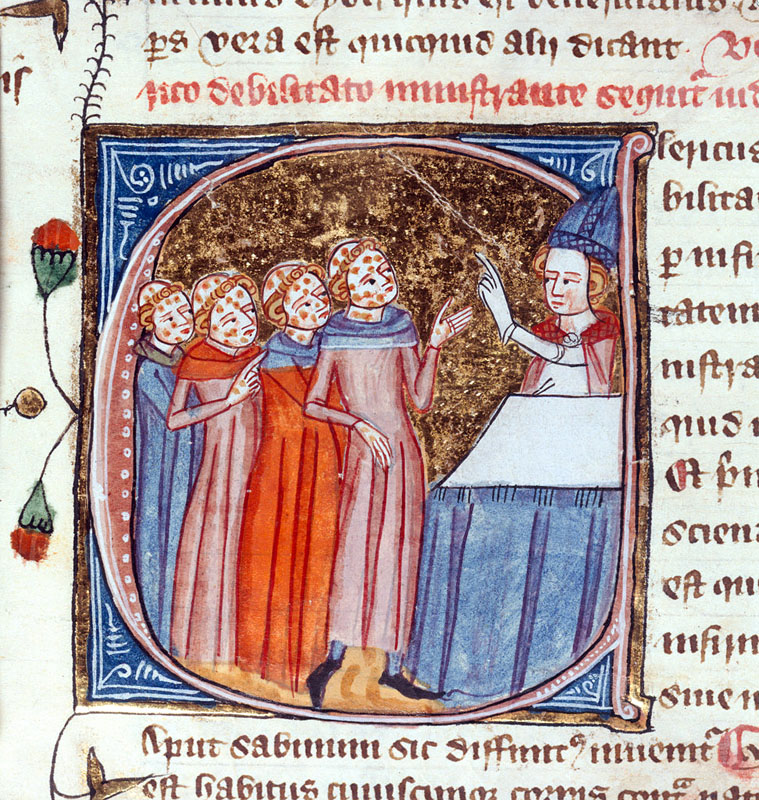
Clerics with leprosy receiving instruction from a bishop.
Courtesy British Library. Royal 6 E. VI, f.301.
Another objection to the Leper Window Theory was well described by the Rev J. F. Hodgson in his comprehensive article of 1900.9 In it he pointed out a number of examples of low side windows installed in churches which were close to leper hospitals, rendering them wholly superfluous if their only use was to tend to the needs of lepers; e.g. Mitton, Lancashire which has a low side window, but had a leper hospital in the parish itself, and St Stephen’s church in St Albans where there was a hospital within five hundred yards.
It follows that LSWs were installed primarily to serve the needs of the local congregation, and not itinerant or individual lepers living in the community. Their needs were well catered for in communal hospitals specifically established to care them, or at the very least isolate them. That is not to say that some LSWs may have been installed in parish churches for lepers to receive confession, especially any which were executed in the 12th century. However, dating the installation of LSWs is difficult at best due to the paucity of records.
References & Footnotes: Use your browser's Back button to return to text.
- Transactions of the East Hertfordshire Archaeological Society 1904, pp242-245. See also Buckland Church, Hertfordshire. Discovery of a “Confessional Window: The Builder 1854-08-26: Vol 12 Iss. 603, p453.
- Hertford Mercury and Reformer - Saturday 13 October 1888, p4.
- The Antiquary. August 1894: Vol 30, p50.
- Newman, G. MD. Prize Essays on Leprosy: Leprosy as an Endemic Disease in the British Islands. 1895.
- The Builder 1856-09-27: Vol 14 Iss. 712, p531.
- Canons of the Third Lateran Council – 1179AD. Canon 23. https://www.papalencyclicals.net/councils/ecum11.htm.
- Shapter, Thomas. A few observations on the Leprosy of the Middle Ages, 1835.
- The charter is undated, but was instituted during Bishop Bartholomew’s tenure.
- Hodgson, J. F. On Low Side Windows. Archaeologia Aeliana Vol XXIII, published in 1902.