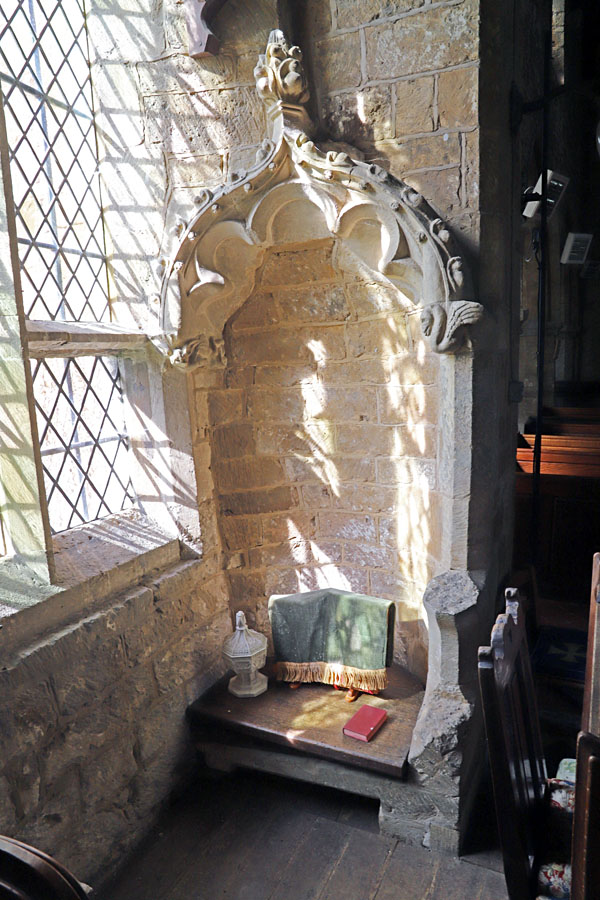
Low Side Windows in English Pre-Reformation Churches
7
The Black Death in England 1348 – 1351
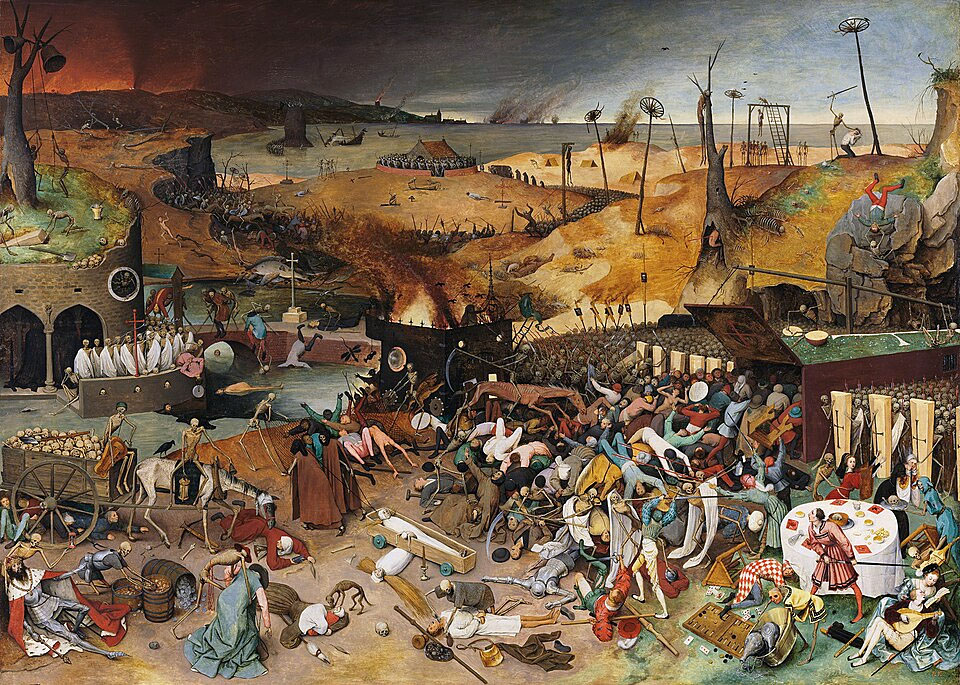
The Triumph of Death by Pieter Bruegel the Elder.
This depicts the results of a pandemic. PD Image.
The Triumph of Death by Pieter Bruegel the Elder depicting the results of a pandemic.
PD Image

The emergence of the "Leper Window" theory in the 19th century, and its tenacious hold on the popular imagination was unfortunate, as it appears to have resulted in earlier writers on the subject neglecting other deadly diseases which had ravaged the general population over the centuries; not least the most destructive of them all - bubonic plague. Non of the earlier writers on the subject of low side windows seems to have considered that any disease might give reason for installing one, leprosy being the only disease worthy of discussion, and that was almost universally dismissed as the reason for occurrences of low side windows. It is not within the scope of this essay to reconsider the history of the Black Death in England in any depth. This is covered comprehensively elsewhere by many scholars, and the reader is referred to the bibliography. The Plague, Black Death or Great Pestilence made land-fall in England in June 1348 at Melcombe Regis (now Weymouth), Dorset, having spread across Europe from the Far East. From there the disease made steady progress through the country, moving north, east and west, reaching London by the autumn of 1348. By the summer of 1349 few areas were left untouched, and a significant proportion of the population was dying. There is some suggestion that the disease also arrived through other ports in the north of England, so the pattern of the spread was more a scattered “bombardment” rather than a “ripple” out from an epicentre. In any case, by 1350 some 30% of the general population were dead, and of the clergy, perhaps 50%. In some monastic institutions virtually all the inmates succumbed.
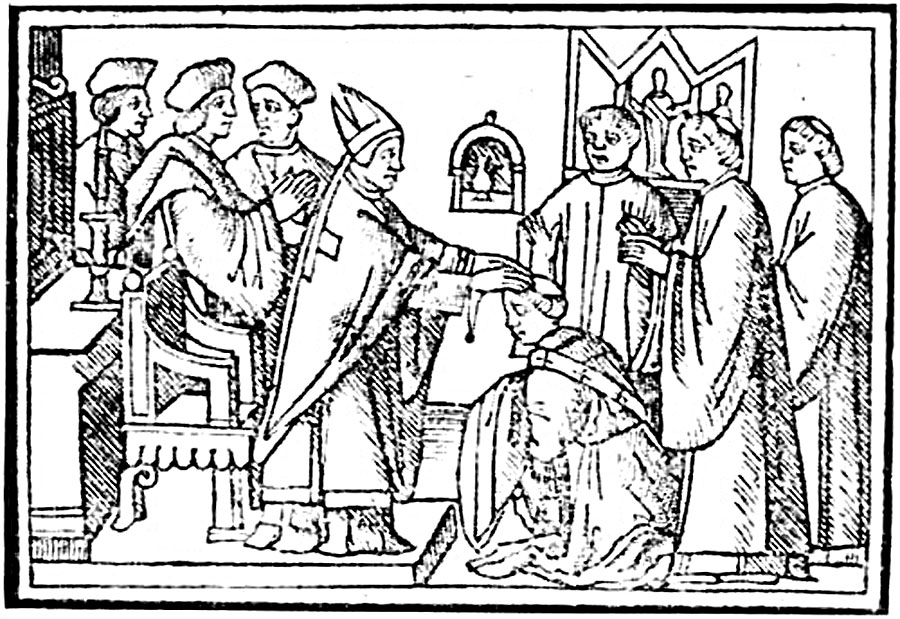
The Ordination of a Deacon from a printed pontifical (471 f. 2.) 1520 BCE
The effect on the clergy between 1348 and 1351 was devastating, and keenly felt, and reference to the many records of rectors found in parish churches today provides plenty of evidence of the dreadful toll on incumbents during that time. By way of examples, of the nearly eighty churches with low side windows recorded by Houghton in his survey of Warwickshire,1 Dugdale 2 lists fifty-seven of those whose incumbents changed over that short period (some more than once - e.g. Ladbroke, Ashow, and Brinklow to mention just a few). In Somerset the ecclesiastical records for the plague years were exhaustively studied by Francis Gasquet. He found that in the months before the coming of the plague in July 1348 just a handful of inductions to livings had been performed. By December it had risen to thirty-two. In 1349, the diocese of Bath and Wells had 232 vacant livings, against a previous yearly average of thirty-five.3 In the diocese of Hereford, institutions to benefices in 1348 were eleven. In 1349 there were 160 with fifty-six benefices recording the reason for change as the death of the previous incumbent.4 Devon and Cornwall faired no better. Many of these incumbents (though not all) were likely to have succumbed to the pestilence. Parishes which had an incumbent rector, and perhaps a curate, suddenly found themselves with no priest at all. Those that had not fled for their own safety were more likely to become infected than the general population as their pastoral duties would bring them into close contact with dying parishioners on a daily basis.
As the death toll amongst the clergy began to rise it became more and more difficult to fill vacancies, and bishops around the country adopted extraordinary measures to ensure a satisfactory supply. Normally ordinations only took place at a relatively small number of occasions during the year. However, in October of 1349 the Archbishop of York, William Zouche, petitioned the pope in Avignon, "In consideration of the scarcity of priests, by reason of the pestilence and mortality in [the] province", to grant a dispensation for the ordination of clerks to all holy orders at any time in a single year. Moreover (and radically so) he sought permission to ordain forty clerks who were underage and illegitimate, both of which would normally bar a man from ordination.5
Other bishops and abbots would obtain similar dispensations during the initial years of the Black Death, as well as in later eruptions of the disease between 1361 and 1363. Even as late as June 1364 the Bishop of Worcester, William Whittlesey,
was petitioning the pope to permit the ordination of men of twenty years old because, "In the recent pestilence nearly all the elders and priests in divers monasteries and religious houses in England have died, and there is a great lack of chaplains to serve churches..." 6
These young men were ill equipped, inexperienced, in some cases illiterate (or only semi-literate), and lacking in the skills to administer the Eucharist according to the Roman rite, let alone have the worldly wisdom to properly direct a penitent to a suitable penance.
Not only that, but the incomes of many of the beneficed clergy had decreased significantly as a direct result of the decline in the population through mortality. These young and inexperienced clergy may not have been so inclined to engage quite as closely with their parishioners as their predecessors for such megre returns, especially given the mortal jeopardy they faced.
People’s faith in the Church was severely shaken by the ravages of the Black Death. Priests who were supposed to protect their flock died as readily as the lay parishioner, but laymen would still have looked to the church for salvation, and (as already discussed above) the sacrements of confession and penance were very much a way of achieving that. But how could confession be conducted safely? Priests fleeing or shutting themselves in the churches fearful for their own lives were of no use to their parishioners. Those that stayed (or their replacements had they died) would require a modicum of solace that their lives would be protected, and allow them to at least perform one of their duties - to hear confession and grant absolution. A low side window would provide a small degree of protection, physically separating the priest from the parishioner, but still allowing communication. If lockdowns were in force, and a priest was unwilling to visit his parishioners’ houses for fear of contracting the contagion, then confession in the open air was an obvious solution, but would not provide the same level of comfort as a thick wall and narrow opening. Philip Ziegler, in his book on the subject 7 paints a mournful picture of the progress of the Black Death in a hamlet in the south of England. Though fictional, Ziegler’s story clearly reflects the reality of life in a plague affected English community. In his story, and as the villagers succumb to the pestilence (the priest dies first), those who survive become morose and disenchanted. Acts of vandalism occur, such as breaking into the church to chop up the pews for firewood.
It is not hard to imagine the fear engendered in the population of a town or village caused by the possibility that an incurable plague might suddenly strike. The vectors of a contagion were poorly understood, the pathogen not at all, even by so-called “physicians”, but the necessity of maintaining a separation from one’s neighbour would have been clear to all. If the church was to continue to fulfil its mission of saving souls, how could services be continued, and confessions heard inside the body of the church itself – the proper place for such rituals – without putting the parish priest at deadly risk? It was his ministry, after all, which was the safest way to absolution, and his preservation of the utmost importance.
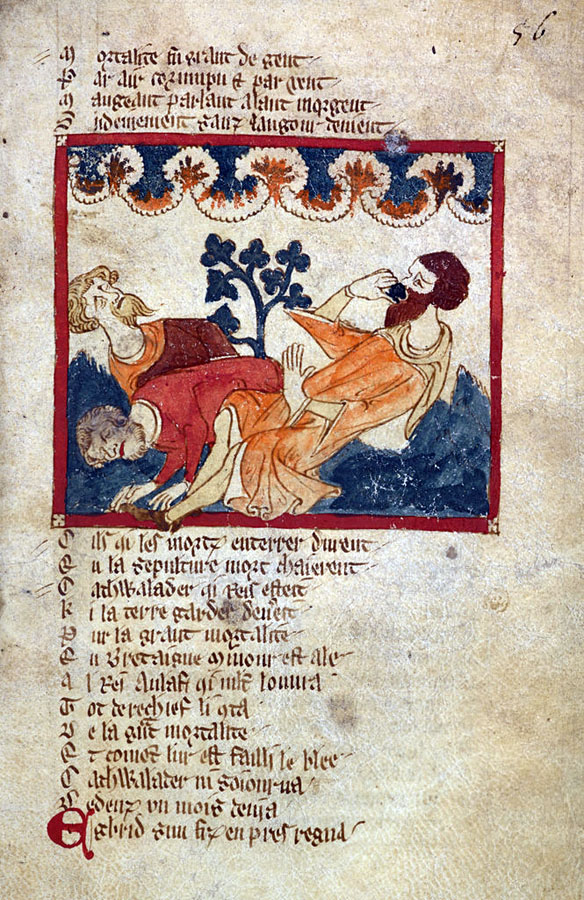
Death from Pestilence, from ROMANCES in French verse. 14th century. Courtesy British Library MS Egerton 3028.
Death from Pestilence, from ROMANCES in French verse. 14th century. Courtesy British Library MS Egerton 3028.
The years between 1348 and 1351 saw a dramatic reduction in the number of ordained priests as they succumbed to the pestilence. Zentner notes; “
Not only was the Church expected to alleviate the chaos and anxiety of European Christians during the first year of the plague, but it was expected to do so in a weakened and debilitated state”.
8 Relieving that anxiety by allowing parishioners into churches to pray and receive Holy Communion, and confess, a prerequisite in their minds for them to secure eternal life, a place in heaven, and ultimately resurrection, would put the already severely depleted clergy at unacceptable risk of infection and almost certain death. Exclusively outdoor services may also have been out of the question as a result of interpretation of Canon Law of the medieval period which decreed that the Eucharistic service be performed "in a sacred place”. That most sacred place is the church building itself, particularly the high altar where the Host is raised. Though the law allowed for exceptional circumstances (and bubonic plague would have qualified in that respect) it would have been a significant departure from the norm. Furthermore, although outdoor services would have been safer than congregating indoors, the priest may still have been happier to remain closeted inside and away from possible contagion, literally in his “sanctuary”, while the parishioners would have been happier to witness the Eucharist on consecrated ground as near to the sacred act as possible. In the minds of parishioners, preserving an ordained priest who was the only one authorised to perform the Eucharist and (importantly) read a dying person their last rites would have been of paramount importance. However, due to the severe depletion of the clergy’s number, it was not uncommon during the plague years for those who were dying being in serious jeopardy of not receiving extreme unction from a priest, giving rise to another exception to Canon Law, at least on a regional basis. By the close of the year 1348, a terrible toll had been exacted on the clergy. In a letter written in 1349, the severe reduction of the number of priests in the south west of England was addressed by the Bishop of Bath and Wells, Ralph Shrewsbury. Gasquet writes:
“
Every bond was loosed, and every ordinary ecclesiastical regulation and provision set aside, because none could now be enforced, or, indeed, observed.”
9
In his letter the bishop highlighted the distressful situation of Christians that were without the sacrament of penance. In his decree, he ordered his clergy to notify their parishioners that should an ordained priest not be available, then a dying person could make their confession to a layperson, “..even to a woman if a man was not available”.10 The bishop wrote:
"The contagious nature of the present pestilence, which is ever spreading itself far and wide left many parish churches and other cures, and consequently the people of our diocese, destitute of curates and priests. And inasmuch as priests cannot be found who are willing out of devotion, or for a stipend to undertake the care of the foresaid places, and to visit the sick and administer to them the Sacraments of the Church (perchance for dread of the infection and contagion), many, as we understand, are dying without the Sacrament of Penance. These, too, are ignorant of what ought to be done in such necessity, and believe that no confession of their sins, even in a case of such need, is useful or meritorious, unless made to a priest having the keys of the Church. Therefore, desiring, as we are bound to do, the salvation of souls, and ever watching to bring the wandering from the crooked paths of error, we, on the obedience you have sworn to us, urgently enjoin upon you and command you — rectors, vicars, and parish priests — in all your churches, and you deans, in such places of your deaneries as are destitute of the consolation of priests, that you at once and publicly instruct and induce, yourselves or by some other, all who are sick of the present malady, or who shall happen to be taken ill, that in articulo mortis, if they are not able to obtain any priest, they should make confession of their sins (according to the teaching of the apostle) even to a layman, and, if a man is not at hand, then to a woman. We exhort you, by the present letters, in the bowels of Jesus Christ, to do this, and to proclaim publicly in the aforesaid places that such confession made to a layman in the presumed case can be most salutary and profitable to them for the remission of their sins, according to the teaching and the sacred canons of the Church.”
After making an injunction that any confessions given to laymen must remain secret, the bishop goes on to decree that those who come to confession to priests “having the keys of the church” before they become sick, forty days of indulgence:
"And since late repentance, when, for example, sickness compels and the fear of punishment terrifies often deceives many, we grant to all our subjects, who in the time of the pestilence shall come to confession to priests having the keys of the Church and power to bind and to loose, before they are taken sick, and who do not delay till the day of necessity, forty days of indulgence. To every priest also who shall induce people to do this, and hear the confessions of those thus brought to confess whilst in health, we grant the same by the mercy of God Almighty, and trusting to the merits and prayers of his glorious Mother, or the Blessed Peter, Paul, and Andrew the Apostles, our patrons, and of all the Saints.”
Indeed, Gasquet asserts that as mortality increased and it became clear that no one would be spared (including men who were perceived to be closest to God – the clergy), even priests began to refuse to hear confession.
11 Given Bishop Ralph’s command, the parish priest would have been partially relieved of his duty to receive a dying parishioner’s confession by episcopal decree, that duty having been passed to any available layperson (including a woman)! The priest could therefore isolate himself from the worst of the contagion inside the church while still performing at least some of his sacred functions if he so chose. This would also be the case for itinerant friars who temporarily administered during an interregnum. It would depend on how the bishop’s letter was interpreted. The Bishop wrote,
“…Inasmuch as priests cannot be found who are willing out of devotion, or for a stipend to undertake the care of the foresaid places, and to visit the sick and administer to them [the dying] the Sacraments of the Church..” If an incumbent had died and there was no priest available locally, then the bishop’s words would rest at face value, and be unambiguous. However, if the incumbent was well and unaffected by the disease, he could have interpreted the bishop’s words as giving him
permission to refuse to attend a dying parishioner. If the incumbent priest had succumbed to the pestilence, and his position had been back-filled by another priest (and many young and inexperienced men were ordained with haste to do so), the new incumbent may have been equally as unwilling to expose themselves to unacceptable risk. The provision of a low side window in the church, located close to where the priest would normally hear confession (i.e. the junction of the nave, where the common folk stood, and the chancel, the area allocated to the priest), would provide a modicum of protection through what, in modern parlance, is known as social distancing, and perhaps make him more willing to continue to hear confession. Moreover, further protection against contracting the disease could have been made by furnishing the opening with a linen or muslin cloth soaked in lime or vinegar, or surrounding it with flowers and herbs which at the time were thought to ward off the contagion by purifying the air. The classic plague doctor’s outfit of ankle length overcoat and beak mask filled with such sweet smelling substances provides testimony to the belief of the efficacy of such precautions. Although the means of transmission of bubonic plague was not well understood, if a muslin cloth had been placed over the opening, it would have provided a good defence against the fleas which carried the disease.
On the matter of laymen hearing confession, and on the last rites the bishop’s wrote:
“You shall further declare to all thus confessing to lay people in case of necessity, that if they recover they are bound to confess the same sins again to their own parish priest. The Sacrament of the Eucharist, when no priest can be obtained, may be administered by a deacon. If, however, there be no priest to administer the Sacrament of Extreme Unction, faith must, as in other matters, suffice for the Sacrament."
Hearing another’s confession in the absence of their priest would present a serious problem to the laity. Not only does the bishop warn the layperson who may hear another’s confession that they will commit a grave sin if they repeat anything said to them, they are also told that anyone who recovers must confess the same sins to their priest. This may have discouraged the lay confessor from hearing a confession, or the penitent giving one to a layperson. The possibility of hearing some grave sin from one of the lay confessor’s friends or family, only to inadvertently blurt out that sin to others would have exercised their minds. Worse still to hear of a sin committed against themselves! Therefore protection of the parish priest would have been a serious consideration. It has to be noted that bubonic plague is rarely passed from person to person, but spread by rats through fleas. Although these vectors were not understood in the 14th century, it would have been fairly soon apparent that a person who had recovered could, if allowed to come into close proximity with another who had not had the disease might cause that other person to become sick, i.e. by carrying those fleas on their clothing. The provision of a LSW for the purpose of protecting the priest using socially distanced confession, especially following recovery would have been a neat solution, and even more so if the original incumbent had succumbed to the disease, and been replaced once or even twice by “new blood”.
12
A New Theory for the existence of Low Side Windows: The Pestilence Theory.
It is conjectured here that in these perilous circumstances, and with the priest having the “keys to the church” and therein shut away, a small opening at a suitable level above ground (a low side window), could serve multiple purposes;
- For use as a confessional so that penitents could perform their duty with the least risk of infecting their priest. This may have been the primary use.
- Given that no one would be permitted to enter the church due to the risk of contagion; For the ringing of a sacring bell to alert a congregation gathered outside, and close enough to the church to hear it, the exact moment of the Elevation of the Host. However, following the discussion in Chapter 5 with respect to Sanctus bell-cotes this theory is not strong.
- To allow the delivery of water and provisions to the priest shut up in his church. This is the weakest of these reasons, as food could have been left outside a door.
The Rev J. F. Hodgson in his essay, “On Low Side Windows”, is extremely dismissive of the confessional theory stating;
“In spite of misunderstood and misapplied texts, then, the ‘confessional’ theory – so manifestly impossible of application in cases out of number, as in those which are too high, or too low, or within a few feet of each other, or so close together that there is only the thickness of a mullion between them, to say nothing of its inherent absurdity – like the scientific hand-bell one of certain superior people, be relegated to the limbo of ‘imagined’ but utterly ‘vain things’.”
Like many writers on the subject, the Rev Hodgson did not dwell on the matter of when these windows were installed, and (also in keeping with other writers) never once seems to have considered that an extraordinary event (or series of events) may have prompted their introduction. In highlighting positional irregularities (too high or too low etc.) he conveniently neglects the fact that the vast majority of windows, as can be clearly seen in the surviving examples, are perfectly suited to confession (i.e. at a suitable height for a confessor to communicate with a penitent outside). Instead, in Chapter 2 of his essay, he begins a long-winded explanation of what he terms, “Of Their True Use and Origin”, and after many chapters quoting at length (and in Latin) the Liturgist William Durand (1230 – 1296), and various treatises in French (neither of which language he translates and therefore likely lost a good deal of his readership) he plumped for the “mortuary light” theory, without recognising that theory's patent absurdity.13 Francis Bond in his excellent book on English Church Architecture published in 1918 asked a number of questions regarding the confessional theory, but made no attempt at answering them. He wrote:
"The theory that they were Confessional windows is supported by the fact that in a very few instances there are seats and book rests. But in some cases the openings are so low down that priest inside and penitent outside would have to lie down. In others they are so high up, that both would have to climb ladders. At Leeds Castle, Kent, the opening in the private chapel is above the moat. Had the penitent to swim the moat .'^ Besides, why should there be two or even three confessional windows in one church? And who heard the confessions? Not the parish priest; it is known from the evidence of illuminations and otherwise that he sat for the purpose in the open church on a chair placed in front of the chancel screen. Why should he move to a hole in the wall, which would give him toothache or a stiff neck? And who were the penitents? Not the parishioners; for from time immemorial they were accustomed to make their confession in open church and certainly would not care to kneel outside in the churchyard at a hole in the wall." 14
Whatever the function of low side windows in a particular parish, that a particular event may have prompted their installation is a significant possiblity which was seemingly ignored by previous writers on the subject. That event may have been a change of liturgical practice, a physical event, or more likely an existential one. If the former then
all churches would have been equipped with low side windows in order to conform. However, many churches do not have low side windows, and never had them, so it is safe to assume that a fundamental change in
official or episcopally mandated liturgical practice was not the primary reason for their installation. The natural conclusion to be drawn from the foregoing is that the rise of LSWs was directly connected with the emergence of epidemics, whether they be bubonic plague, or another virulent disease. For this to stand it will be necessary to correlate the date of installation of a LSW in a particular church and an outbreak of disease in the parish, or the anticipation of such a disease after having suffered it already – no easy task. The Black Death (1348 - 1351) is the most obvious contender for the rise of LSWs as it was one of the most virulent, widespread and devastating epidemics ever experienced by humanity. It affected the whole country and prompted a common response to the challenges presented to the church and the clergy. It would be easy to back this up conjecturally by quoting Francis Bond’s assertion that most LSWs were installed in the 14th century.
15 However, this does not account for earlier windows, nor is it straightforward dating LSWs without written accounts, and it should be noted that bubonic and pneumonic plagues recurred a number of times in the 14th century and on into the following centuries.
The Pestilence Theory
The Pestilence Theory (if it may be so called – the “Black Death Theory” being too narrow a definition) also has more weight than the leper theory, because leprosy was nothing new in the 14th century when it is said most LSWs were installed. Furthermore, the custom of ringing altar bells seems to have been established well before the first arrival of bubonic plague in England in 1348. The practice is said to have originated during the 11th through the 13th centuries, when “theologians were attempting to define more precisely the way in which Christ is present in the Eucharist”.
16 If the leper theory is the reason for the installation of LSWs,
and it is to be believed that lepers would have been permitted to gather at the boundary of the consecrated ground, then one might expect such windows to have appeared as early as the 11th century. There are scant examples of churches of that date in England, but if the practice were widespread at that time then, following the Conquest, the Normans would surely have, from the outset, incorporated LSWs in their churches to accommodate lepers, and these would be readily evident today. This is not the case, as most LSWs seem to be later additions.
The Physical Location of Low Side Windows
A pre-existing window in a suitable location in the chancel could easily be extended downwards with new jambs and sills, and the internal wall removed below a pre-existing sill to form a low side window. Alternatively a new aperture could be made to provide an opening independent of pre-existing windows. If time or cost were not an issue these new or modified openings could have been well executed, and befitting of the dignity of the church. However, in a great many examples of low side windows we see crude implementation. This would indicate that they were installed in great haste which provides further evidence that a catestrophic event promted their widespread introduction. The particular location for low side windows being at the western end of the chancel is discussed in more detail in the next section.
Other Pestilences
It also should be noted that other diseases were prevalent and well known prior to the 13th century, even if the general populace or their physicians had little, or no understanding of pathogens and their vectors. Creighton asserts that diseases other than leprosy were mistaken for it, “..
or conveniently and euphemistically included under it”.
17 He cites
Lues Venerea, a common form of venereal disease as a possible contender for such misidentification. Ergotism caused by being poisoned with the
Claviceps Purpurea fungus which infects rye and other cereal grains especially after a wet sowing or wet harvest, leading to convulsions, gangrene, and hallucinations, is another contender for a misdiagnosis of leprosy, at least in the early stages of the malady. Six great outbreaks of ergotism in Britain are recorded in the tenth century, seven in the eleventh, ten in the twelfth, and three in the thirteenth, the medieval series ending with one in the year 1373.
18 Creighton, speaking of “famine induced” epidemics in monastic institutions, suggests they were started by the importation of an infection, “universally diffused in English soil”, and “a soil-poison fermenting within and around the monastery walls, and striking down the inmates by a common influence as if at one blow.”
19 Creighton, also lists epidemics prior to the 14th century. Quoting quoting
Chronicon Abbatiae Ramesiensis, Rolls ed. 1886, p. 397, he cites one between 1304 and 1315 which struck down the monks of Croyland resulting in "...a sudden and severe mortality."
And what of the common cold, influenza, smallpox, measles, rubella, typhoid or many other contagious and potentially life-threatening diseases? Many of these are deadly today, despite huge strides in the understanding of infectious diseases, and routine use of vaccines, so these diseases in medieval times would have been greatly feared. It would not be surprising if sufferers of any of these diseases, or, for that matter, any disease likely to have been misunderstood by the general populace, were loosely referred to as, “lepers”, meaning “one who is to be avoided or rejected”, and hence the adoption of the term, “leper window”. Creighton relates a number of instances where the term, “leper” was used as a vague term of abuse.
20 The transmissibility of a pathogen would not necessarily be a factor in a medieval mind. Due to their lack of knowledge it is likely that medieval people, on the basis of exercising utmost caution, would consider all disease to be highly contagious. To do otherwise would expose one to unacceptable risk, and possibly death. Despite the number of outbreaks of disease enumerated by Creighton,
21 many were localised, and not widespread or universal. However, the Black Death was a step change. The prevalence and severity of bubonic plague as it spread across the country in the mid-14th century killing a significant proportion of the population would account for the sudden large-scale adoption and installation of LSWs for the purpose described above.
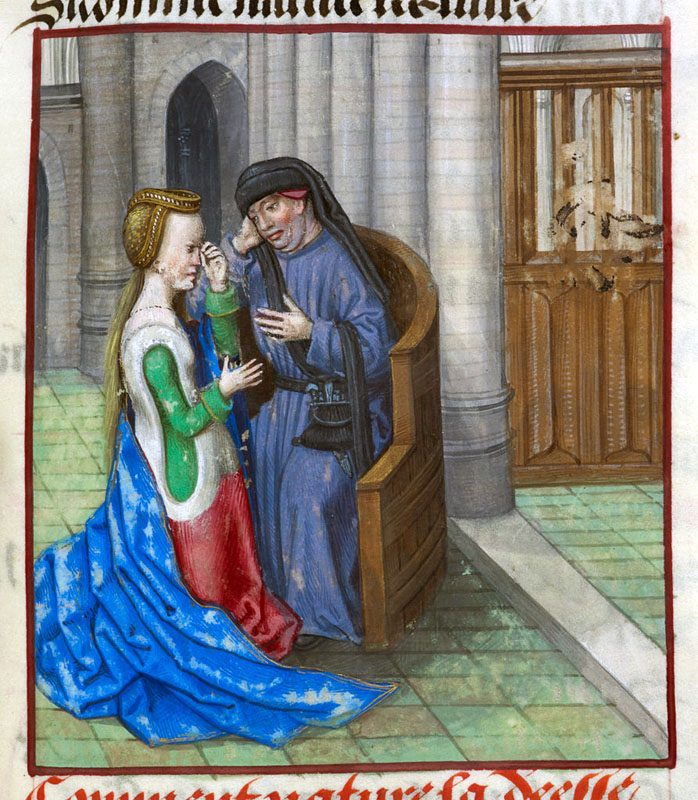
Confessing to a Priest. From Roman de la Rose by De Meun, Jean; Lorris, Guillaume de.
Netherlands, S. (Bruges). c. 1490-c. 1500. Courtesy British Library: Harley 4425. This image clearly shows the priest at the junction of the chancel and the nave, the normal location to hear comfession.
Confessing to a Priest. From Roman de la Rose by De Meun, Jean; Lorris, Guillaume de. Netherlands, S. (Bruges). c. 1490-c. 1500. Courtesy British Library: Harley 4425. This image clearly shows the priest at the junction of the chancel and the nave, the normal location to hear comfession.
That some churches do not have low side windows, or seem never to have had them does not prove fatal to the Pestilence Theory, though one should be wary of false correlations. Some villages were not troubled by bubonic plague or other diseases. Few were abandoned entirely as a result of the loss of the whole population, but may have temporarily been depopulated as people moved away to find work. Also local practices may have varied from parish to parish. It may have been solely at the discretion of the incumbent whether confession should be heard through a low side window (or a Sanctus bell rung), prompting the necessity of installing one. Those priests willing to hear confession face-to-face or open their church as normal would not have required a low side window. Some parishes may not have had a priest for some years during and after an epidemic or lesser outbreak of disease, relying instead on itinerant friars to provide for the spiritual needs of the parishioners, or requiring them to travel some distance to another church. It is difficult to say without more compelling evidence. However, the Pestilence Theory is perhaps the most plausible of theories to account for the abundance of this curious architectural conundrum, and it is most likely that low side windows’ primary purpose was as a confessional. This is particularly evidenced by the provision of internal seats, some of which are quite elaborate (e.g.
St Giles, Wigginton, Oxfordshire).
St Giles, Wigginton, Oxfordshire. Inside, the low side window has been provided with an elaborate canopied seat. In this case the low side window has been created by adding a transom to an existing window.
Most importantly, the location of the vast majority of low side windows, being at the junction of nave and chancel cannot be ignored. During normal times this would have been the place allocated to hear confession; the priest sitting just inside (or very near to the chancel), and the penitent just outside in the nave. If a rood screen were in place, then a curtain could be drawn to separate penitent from confessor. Were low side windows installed for any of the other theories listed, perhaps with the exception of the Santus bell theory, they could have been installed almost anywhere in the church.
John Cornwell in his book on the history of confession and the confessional paints an interesting picture of priests in rural parishes whose workload increased dramatically during Lent and Holy Week as a result of the decree of the Fourth Lateran Council (See page 6) when parishioners flocked to the church to give their annual confession.22
"Priests complained of having to hear as many as three hundred confessions in a single day. The priest usually sat on a chair in the sanctuary, the penitent keeling beside him, or in front of him. There were unruly scenes when people refused to wait their turn, and there was a tendency among penitents to eavesdrop."
Having a "snaking line" of impatient penitents gathered inside the church during a time of pestilence would have been unthinkable due to the risk of transmission. The modern equivalent of this scene would be the long "socially distanced" queues outside supermarkets during the COVID 19 pandemic of 2020 - 2022. The first outbreak of the Black Death spanned at least the two Lenten periods of 1349 and 1350 when penitents would not have been permitted to enter the church to confess. The low side window would provide a solution, keeping everyone outside and "socially distanced" from the priest.
Philip Mainwaring Johnston writing in Sussex Archaeological Collections
23 suggested that some low side windows may have been connected with monastic institutions which “farmed” the livings of parochial churches belonging to them rather than instituting an incumbent vicar. He wrote:
“Now it is a well-ascertained fact that the rivalry which soon sprang up between the various orders of friars and the monastic bodies led to the latter modifying their habits of seclusion and adopting, to some extent, the friars' methods. And it is equally certain that, instead of instituting a permanent vicar, these monastic bodies frequently "farmed" the livings of the parochial churches belonging to them, and served them by monks, who either resided temporarily in cells or clergy-houses attached to, or in the neighbourhood of, the church, or else journeyed to and fro between the parish church and the parent monastery to perform the requisite offices. Among the duties of these brethren must undoubtedly have been that of hearing private confessions, in the performance of which function it seems not unreasonable to suppose that some distinction would be made between the method of the secular clergy and that of the regulars — such as would be expressed in priest and penitent being separated by the external wall of the church, and the confession being made through a window.”
This may account for some low side windows, but no evidence has yet come to light for this project to substantiate this ascertion. Mr Johnston's belief was that low side windows were installed for confessional purposes, particularly linked to the rise of the friars in the latter half of the 13th century, and that most of the windows were installed during a period when these friars had most influence.24
The next chapter focuses on another aspect of low side windows which was somewhat neglected by previous writers, but which provides further compelling evidence that they were installed primarily for confession - their location at the western end of the chancel.
Back to Contents
References & Footnotes: Use your browser's Back button to return to text.
- Houghton, F. T. S. Low Side Windows of Warwickshire Churches, Birmingham Arch Soc 1906.
- Dugdale, W. The Antiquities of Warwickshire 1656.
- Deaux, Geo. The Black Death: 1347. Weybright & Talley, New York. p120.
- Dohar, William, J. The Black Death and Pastoral Leadership. The Diocese of Hereford in the Fourteenth Century. 1995. Table 2, p42.
- Bliss, W. H. Ed. Calendar of entries in the Papal registers relating to Great Britain and Ireland. Petitions to the Pope 1342 - 1419. (f. 46.) dated 4 Oct 1349.
- Ibid.(f. 190.) dated 4 June 1364.
- Ziegler, P: The Black Death – The Plague in a Medieval Village; 1969, p202.
- Zentner, McLaurine H. The Black Death and Its Impact on the Church and Popular Religion, 2015, p7.
- Gasquet, Francis Aidan, (1846-1929): The great pestilence (A.D. 1348-9), now commonly known as the Black Death. 1893, p81.
- Aberth, John, ed. The Black Death: The Great Mortality of 1348-1350: A Brief History with Documents. New York: Bedford/St. Martin’s, 2005.
- Gasquet, Francis Aidan, The Great Pestilence (A.D. 1348-9), now commonly known as the Black Death. 1893, p13. Although Gasquet speaks here of continental Europe, it I likely that the practice of abandonment spread to England as well.
- Gasquet mentions “with considerable certainty” that fully half of the beneficed clergy in the diocese of Bath and Wells fell victims to the disease. Many livings were rendered vacant two and three times during the plague’s course; whilst a not inconsiderable number had four changes of incumbents within the months between August 1348 and January 1349.
- In his comprehensive essay, “On Low Side Windows” published in 1902 (Archaeologia Aeliana, or, Miscellaneous tracts relating to antiquity - Society of Antiquaries of Newcastle upon Tyne) Hodgson quotes extensively from William Durand’s book Rationale divinorum officiorum (Rationale of Divine Duties) a liturgical treatise written in Italy before 1286, on the origin and symbolic sense of Christian ritual. Durand’s book presents a picture of the liturgy of the 13th century in the West, studied in its various forms, its traditional sources, and its relation to the church buildings and furniture. It long served as a major authority on medieval Latin liturgy and ran through various editions from its first printing in 1459. (Wikipedia).
- Bond, Francis: An Introduction to English Architecture from the 11th to the 16th Century, OUP, 1913.
- Ibid.
- https://archwaysmag.org/when-and-why-do-the-altar-servers-ring-a-bell-at-mass.
- Creighton, Charles. A History of Epidemics in Britain, 1891, p69.
- Ibid. p53.
- Crieghton, Charles. Hist. of Epidemics in Britain.
- Ibid.
- Ibid.
- Cornwell, J. The Dark Box: A Secret History of Confession. 2014. p20.
- Johnston, P. M. Low Side Windows in Sussex Churches: Sussex archaeological collections relating to the history and antiquities of the county. Vol XLII, 1899. p119 etc.
- Ibid. p201.