
Confession in Pre-reformation Churches
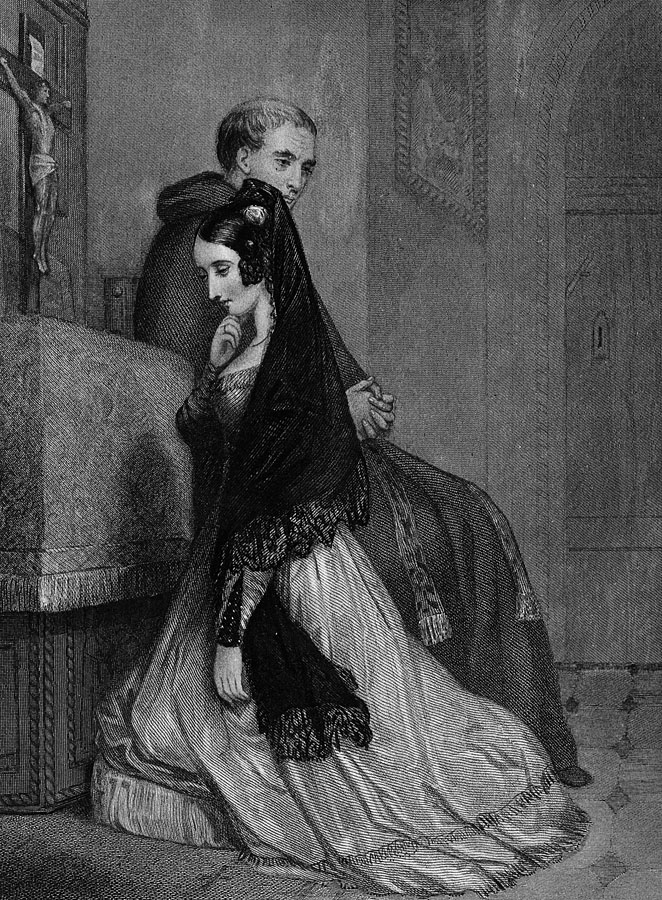
A woman confessing to a priest. Engraving by H. Austen after J. Herbert. Wellcome Collection. Source: Wellcome Collection.
PD Image.
PD Image

Confession was first introduced into the Roman Church on a voluntary basis in the fifth century by the authority of Pope Leo the Great, but it was not until the Fourth Lateran Council in 1215, under Pope Innocent III, that private auricular confession was made compulsory and all Roman Catholics were required to confess and to seek absolution from a priest at least once a year.1 The newly enacted canon law (Constitution 21) required the confession of all sins by every believer at least once per year, to study to the best of his ability the penance he was asked to perform, and to reverently receive the Eucharist at Easter. Annual confession was also given during Holy Week. If this was not done, so said the canon, the penitent would be denied entrance to the Church, and at death be deprived of a Christian burial - effectively excommunicated.2 To make matters worse for the believer, if they did not obey this command, they were pronounced guilty of mortal sin and damned to hell for eternity. An objection to LSWs being installed for outward confession is that confessions would, in normal circumstances, be heard in the body of the church, and not require the penitent to languish outside, especially when suffering the burden of inclement weather. Indeed Canon Law required (and still requires) confessions to be heard in a church or oratory.3 Before the English Reformation, and unlike the modern confessional booths in Roman Catholic churches which were not introduced until the 16th century, confessions were held in a public space (the church), where both penitent and priest could be seen, but not overheard by others. This was particularly appropriate for women or nuns whose safeguarding could best be managed in this manner. Thus Archbishop Walter Reynolds, in 1322, says in his Constitutions: "Let the priest choose for himself a common place for hearing confessions, where he may be seen generally by all in the church; and do not let him hear any one, and especially any woman, in a private place, except in great necessity." 4 A LSW would of course physically separate the priest and penitent, provide a degree of anonymity, and serve the archbishop’s injunction, as the penitent would be seen by others outside the church. But this situation would not be comfortable for the person who remained outside during inclement weather, unless additional shelter such as a wooden porch had been fitted. Because the 4th Lateran Council decreed that a person who had not obeyed the canon requiring yearly confession was denied entry into the church, a low side window would have been a suitable means of hearing confession of those guilty of the charge. The penitent would be outside and visible for anyone around, and the priest would be receiving the confession inside the sacred building as canon law directed. However, if this practice had been widespread in the late 13th century, then all churches would have been equipped with a low side window. This is not the case, as there are many which do not have them, and have never had them. Houghton suggests the introduction of low side windows coincided with the rise of monastic orders in England, whose monks were given powers to hear confession.5 He points to the Dominicans (Blackfriars) arriving from 1221 and the Franciscans shortly afterwards in 1224. Quoting Wadding, Houghton advances the theory by stating that in 1265 Pope Clement empowered the latter to preach, hear confessions, give absolution, and enjoin penance without the assent of the parochial clergy,6 an injunction reinforced by the aforementioned Archbishop of Canterbury, Walter Reynolds. Houghton continues:
There are a number of issues with Houghton’s assertions in this regard. Firstly, the theory advanced by Houghton would suggest the countryside was awash with itinerant friars readily hearing confessions without the knowledge and/or consent of the parish priest. Under normal circumstances, this is a stretch at best. Secondly, if every parish church had a resident incumbent trusted by the local population and readily available, why confess to a stranger, especially given the entreaty in the Fourth Lateran Council's Constitution on annual confession whcih required a penitent to confess to their own priest, and only with good reason, and their priest's permission, confess to another? Furthermore it would not be particularly difficult or inconvenient for a penitent (especially a woman) to ensure that another person was present to witness, but not hear their confession. If the penitent were a man, the issue of hearing his confession in an “obscure place” would clearly not give rise to a situation of jeopardy which the Archbishop’s injunction was meant to forestall.
The fact that the Fourth Lateran Council of 1215 decreed the less than demanding requirement to take confession, “at least once a year”, would suggest that confessional windows (if this is what LSWs were primarily intended for) were not constantly in use, and therefore demand upon them not that great, especially in sparsely populated parishes. Given the foregoing, why go to such extraordinary trouble and expense of cutting a hole in the church wall for mere occasional use by a handful of people, or just for the penitents who were barred from entry into the church? On the other hand, mass was said daily, and accompanied by the ringing of the Sanctus bell as enjoined by Archbishop Peckham (1281). The latter use would make the installation of a LSW in a church without an existing bell-cote or tower bell, a worthwhile enterprise. Furthermore, if LSWs primary role was as confessional windows for general day to day use, why are there so many dated in the 14th century in churches built prior to that century, more than 100 years after the Fourth Lateran Council, and decades after Peckham’s command?
Biblical injunctions for confession are rather scant. 1 John 1:9 states, “If we confess our sins, he is faithful and just to forgive us our sins, and to cleanse us from all unrighteousness.” Acts 19 speaks of the Ephesians “confessing and shewing their deeds” (Acts 19:18). However, both of these texts are silent on the matter of to whom one should confess. James 5:16 appears to clarify the matter; “Confess your faults one to another, and pray one for another, that ye may be healed”, the words, “To one another” clearly showing that one should make outward confession to another person. It took the early Christian writers to begin to develop what would eventually become Roman doctrine. Tertullian, for example, speaks of confession as an external act, and not performed solely within one’s own conscience, and that accompanying this outward confession must come penitence.7 Moreover, that confession should be to a priest, or even in public. It took nearly a millennia for the Catholic Church to write this into canon law, but once in the law it became incumbent on the faithful to follow it. Confession was, and is, taken very seriously by the faithful. It is a route to everlasting life and absolution of sins through real acts of penitence. At times of strife or existential danger, confession would loom large in the minds of people who truly feared being damned to the horrors of hell for their sins.
We shall return to the issue of confession in the next chapter.
Summary of the Theories for the existence of low side windows
The Rev H. Bedford Pim, M.A. writing in the Archaeological Journal of 1902 sums up the state of 19th century discussions on low side windows:
Of the many theories outlined above it is hard to conclude which, if any, is the most likely to account for the existence of LSWs. Assigning a single particular raison d’etre for the existence of LSWs is problematic. However, as has already been mentioned, the first sixteen theories can be easily dismissed as rather fanciful, and the leper window theory is the least compelling of the last three enumerated above. It is highly possible that there was more than one use for a LSW, that their purpose varied from parish to parish or region to region, or that their purpose changed over time. The variations mentioned in the introduction in type, location, size, shape, height above ground etc. may simply reflect local taste, the disposition of the existing architecture, availability of funds, date of insertion, and ability of the mason rather than any differences in use. Some windows are small, plain, and simple square or rectangular openings. Others are significantly larger, more elaborate, and show a great deal of skill in their implementation. Therefore classification of windows using their physical attributes (as was done by a number of antiquarians) is not especially productive in the attempt to define the purpose(s), or raison d’etre for LSWs.
It is with all the above in mind that we move on to the next section of this essay, in which an argument is put forward to explain the real reason the vast majority of low side windows were installed. Over the last one hundred and seventy years or so, much of the speculation for the reason low side windows appeared concentrate on attempting to explain why they exist; i.e. for what purpose they were used. Few seem to have considered when the windows were installed. Bond suggests that the majority date from the 14th century.9 The Rev F. P. Lowe suggests that the “greater majority” must be assigned to the 13th and 14th centuries.10 An enquiry into the date low side windows were installed may shed light on the actual reason for their introduction, especially if that introduction was over a relatively short period of time, i.e. that many churches across England and Wales acquired the windows within a number of years of each other. It should be noted that the great majority of low side windows seem to have been retro-fitted into the existing church fabric, and not installed when the edifice was initially built. This would suggest that they were installed as a result of a change in liturgical practice, or a peculiar set of circumstances required a change. If, as Bond asserts, most LSWs were installed in the 14th century, it would naturally indicate that during that century an event of sufficient magnitude occurred which would create the near universal need for low side windows in parish churches, something which had not been seen as being required in previous centuries.
It is hard not to believe that that event was the Black Death which ravaged England, Scotland and Wales from 1348 to 1351, returning in 1361-62, 1369, and periodically between 1430 and 1480.
Back to Contents
References & Footnotes: Use your browser's Back button to return to text.
- Fourth Lateran Council 1215: Constitution 21. Link to consitutions at Papal Encyclicals Online.
- Spence, H. D. M. A history of the English Church; 1900, p90.
- Can. 964 §1. “The proper place to hear sacramental confessions is a church or oratory”. The New Code of Canon Law; Pope John-Paul II, 1983 CIC.
- https://en.wikipedia.org/wiki/Confessional.
- Houghton, F. T. S. The Low Side Windows of Warwickshire Churches, 1906.
- Wadding: Annales Fratrum Minorum, II, p101.
- Tertullian: On Penitence and on Purity.
- Bedford Pim, Rev. H. Some Notes on The Origin and Uses of Low-Side Windows in Ancient Churches. Archaeological Journal of 1902.
- Bond, Francis: An Introduction to English Architecture from the 11th to the 16th Century, OUP, 1913. p675.
- Report on the lecture given by the Rev F. P. Lowe to a joint meeting of the Architectural Societies of the Archdeaconry of Northampton and County of Lincoln. Lincolnshire Chronicle - Friday 24 May 1850, p8.