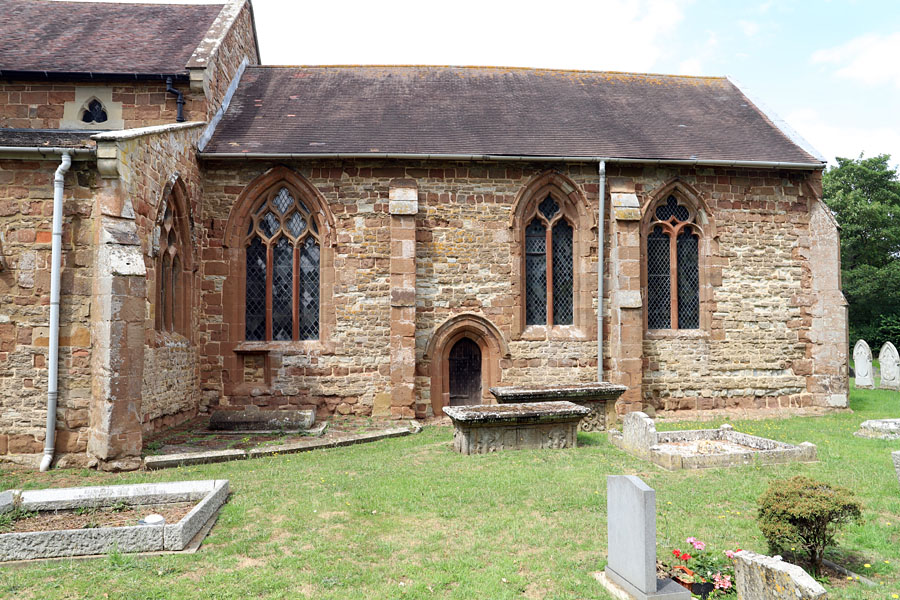
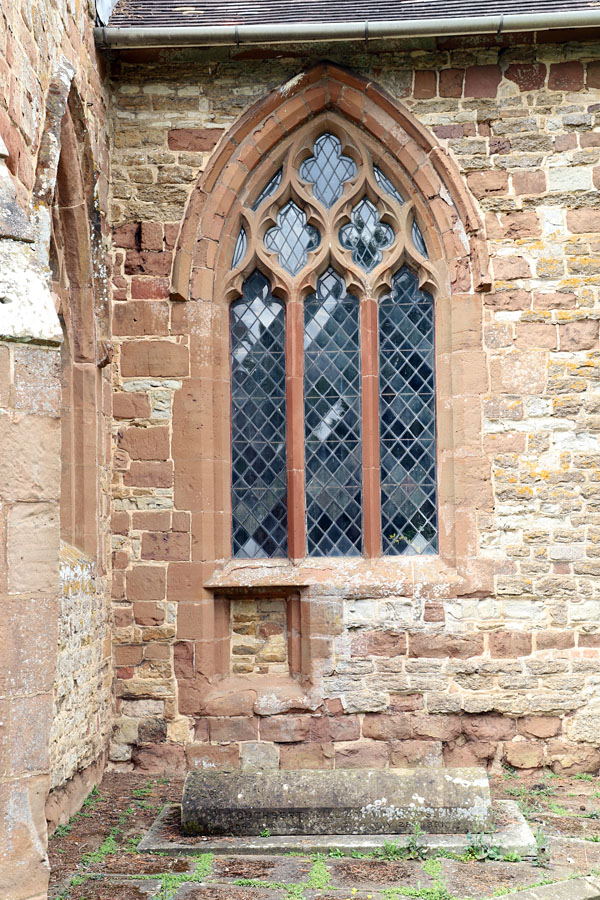
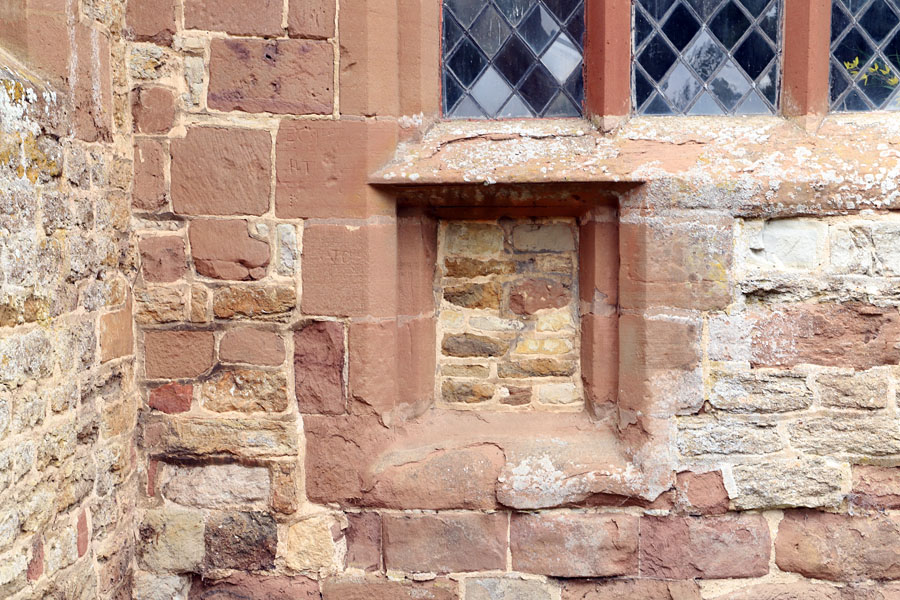
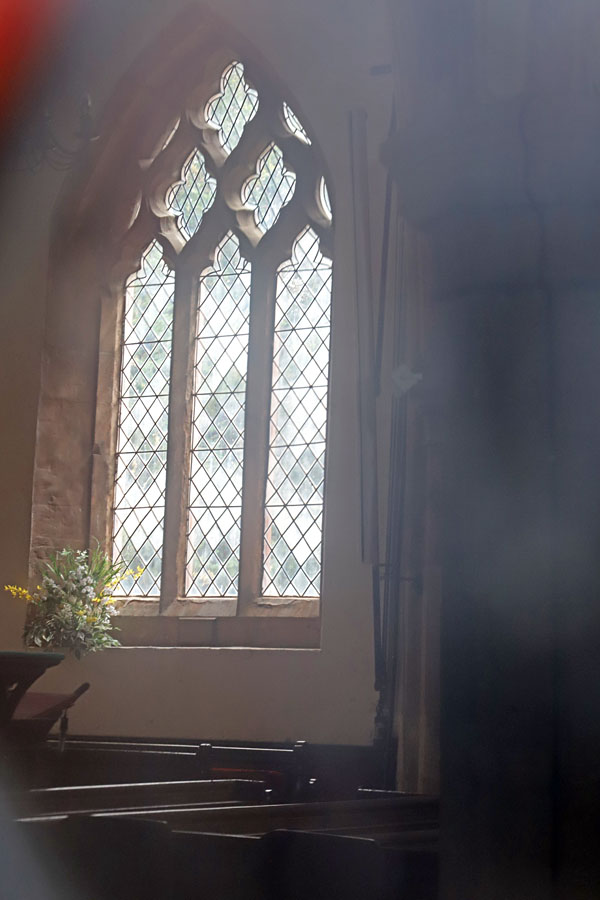
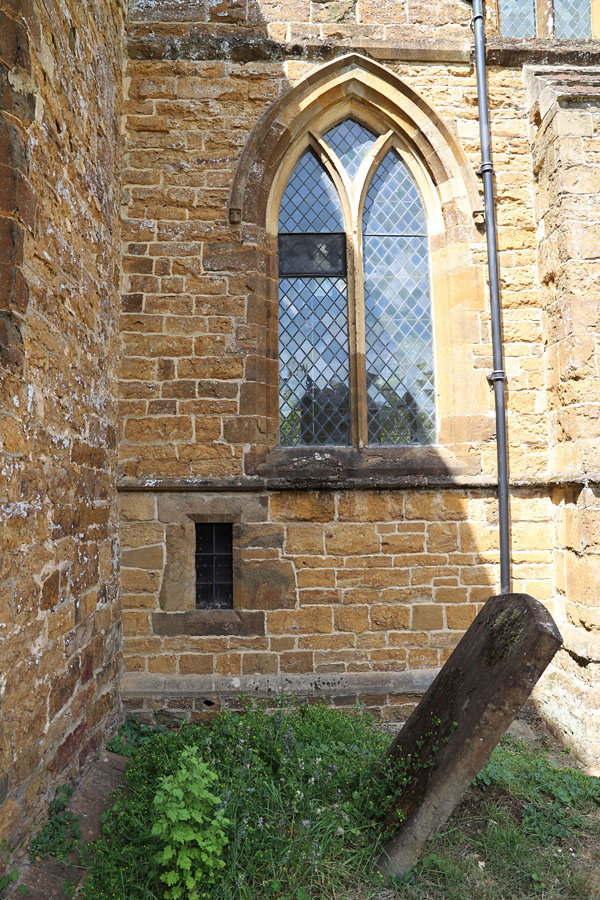
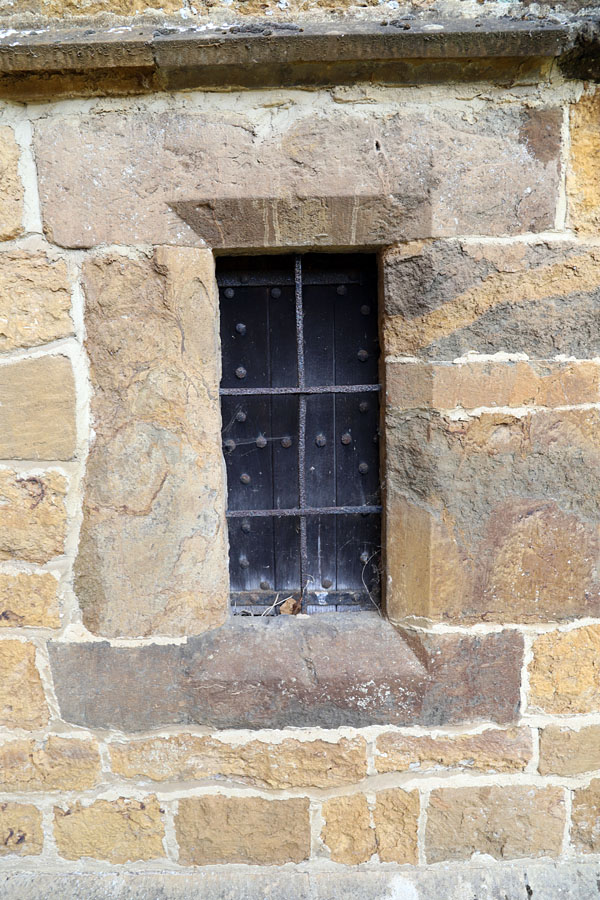
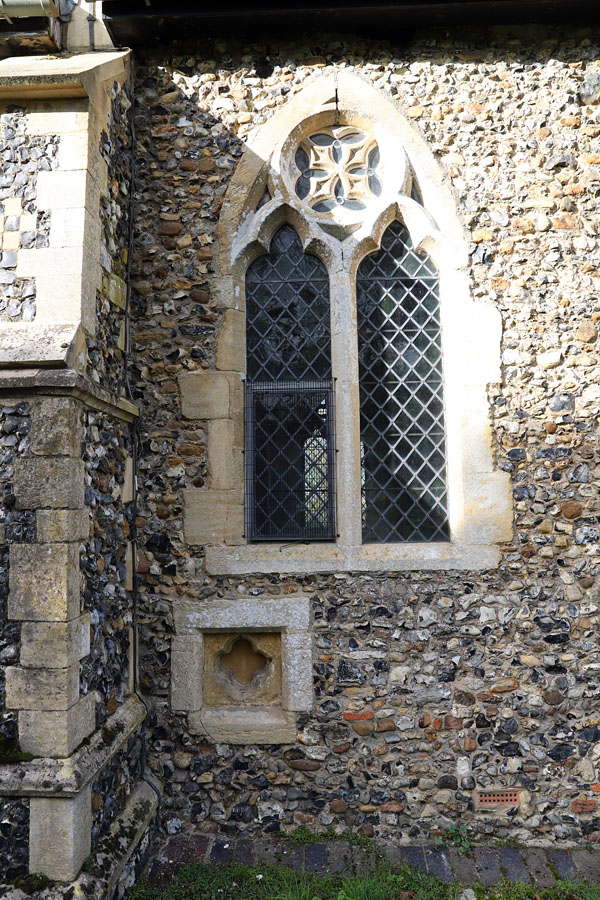
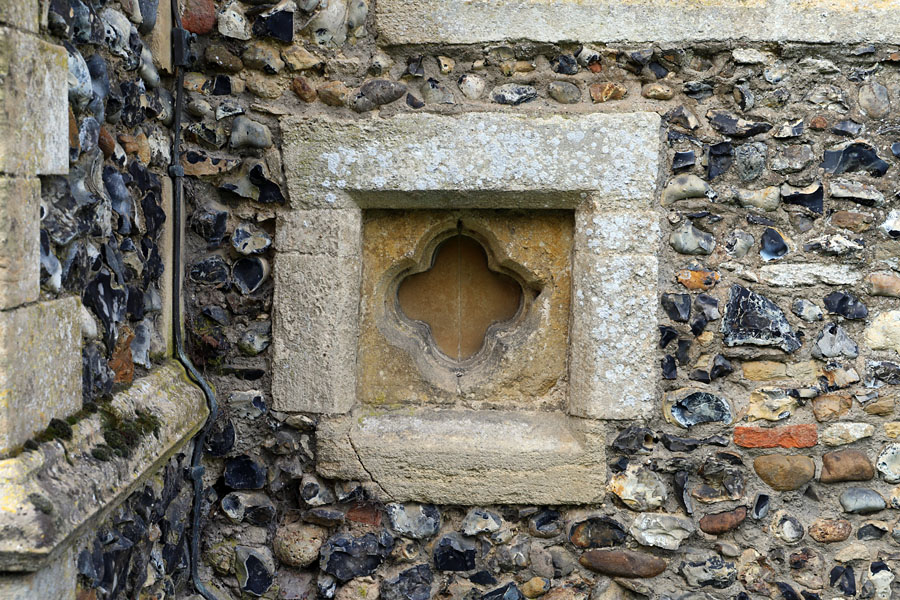
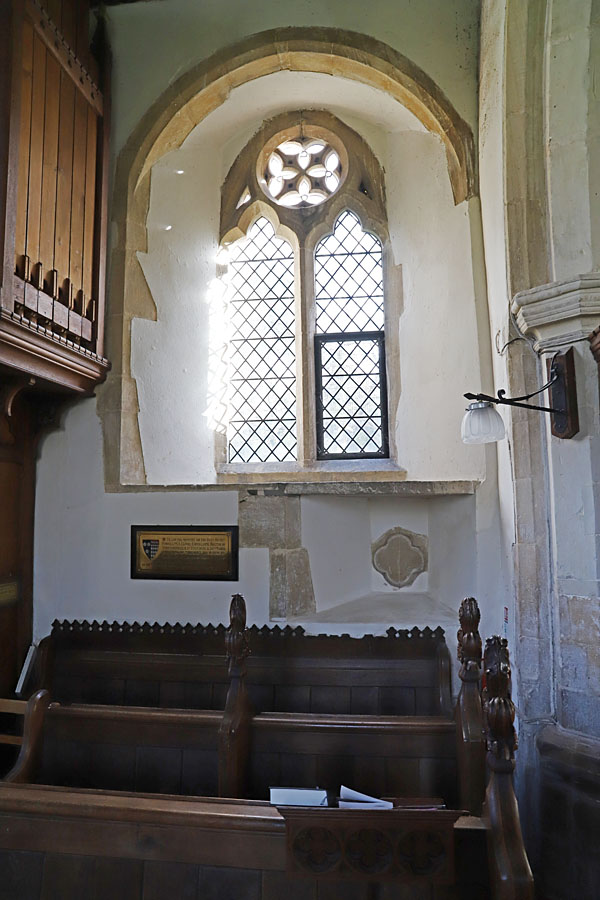
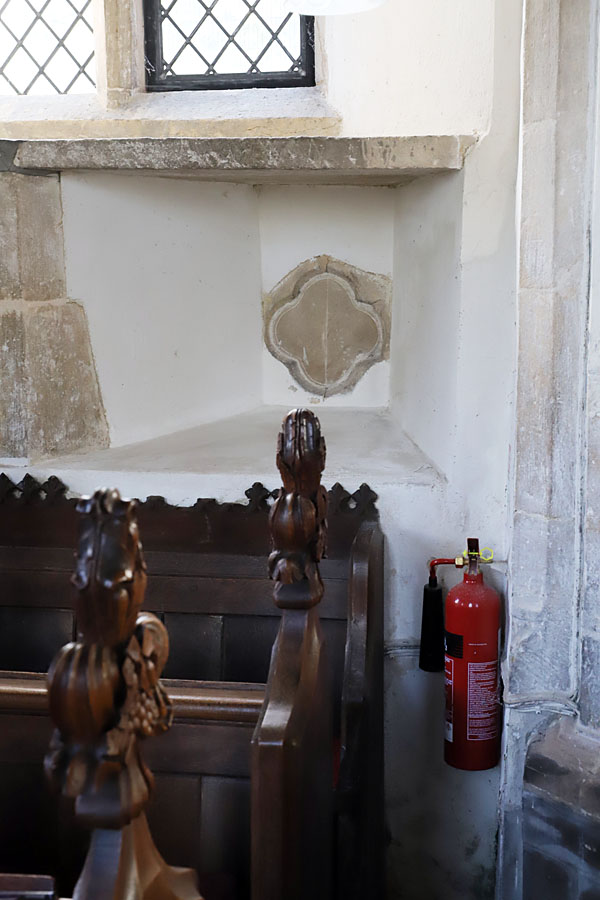
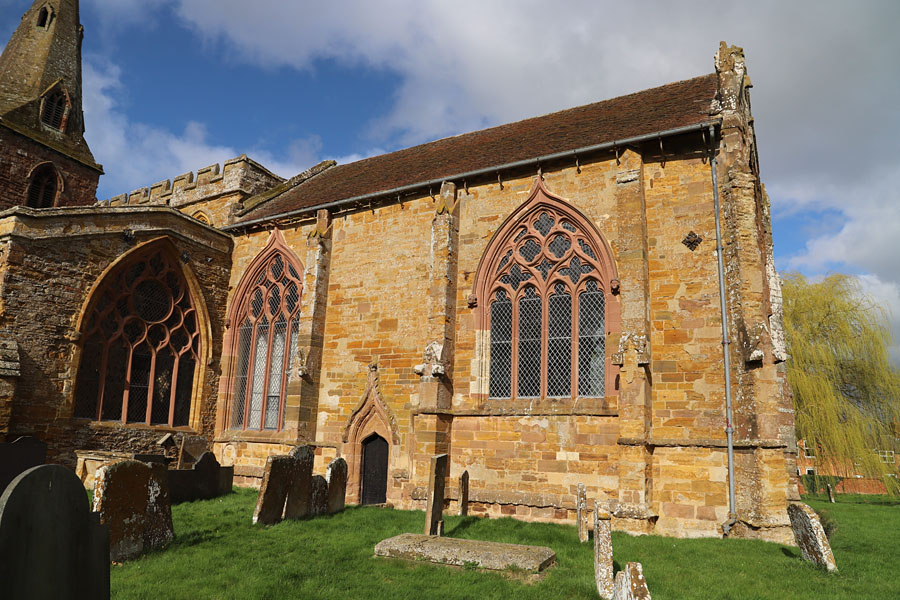
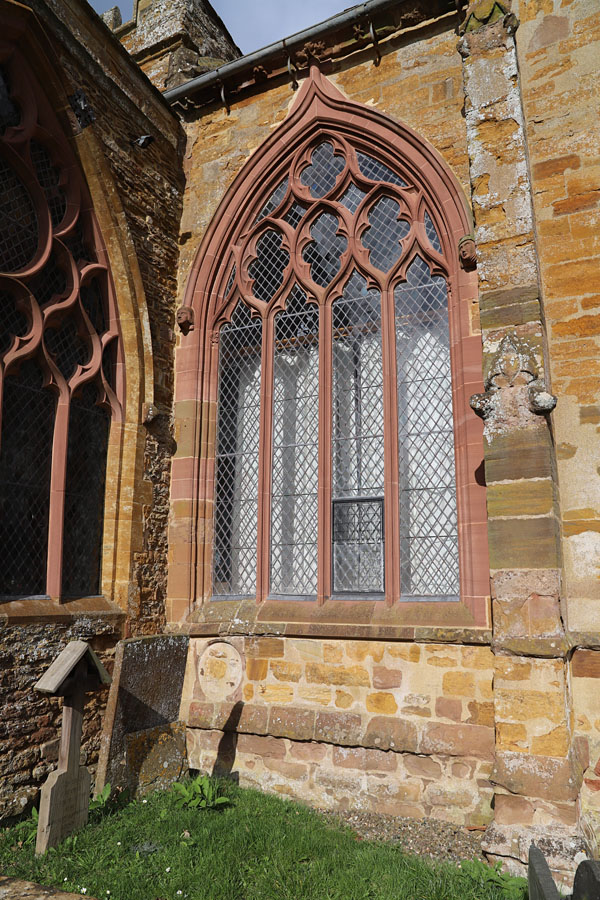
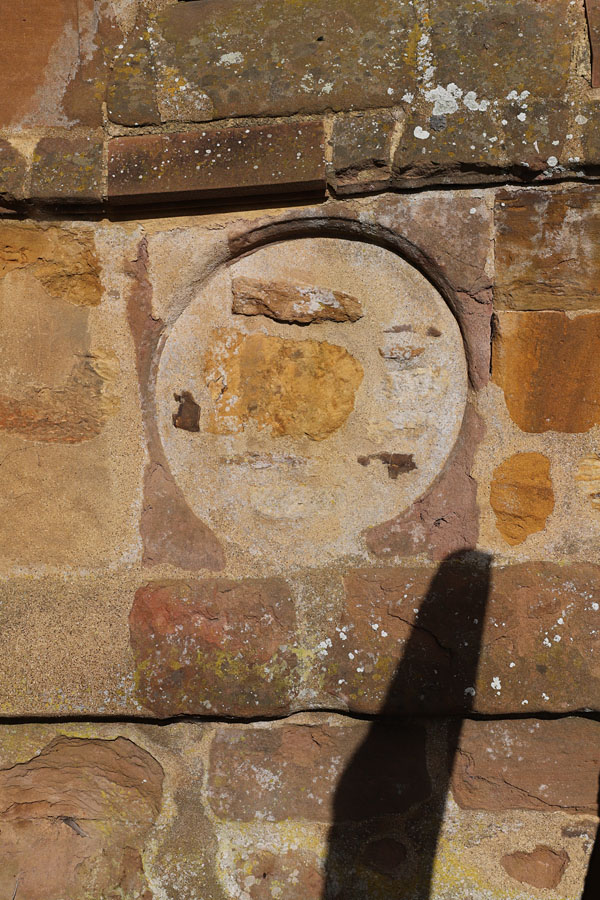
St Peter's is c14. There are three Decorated windows in the south chancel with the low side window added beneath the sill of the westernmost. This is now blocked, and there is no trace left internally.
St Peter, Grandborough, Warwickshire External view of independednt opening, now blocked.
St Peter, Grandborough, Warwickshire External view detail. Note the modified sill of the original window, and the left jamb which has been carefully run down to the sill of the low opening.
St Peter, Grandborough, Warwickshire Internal view. All trace of the opening has been obliterated
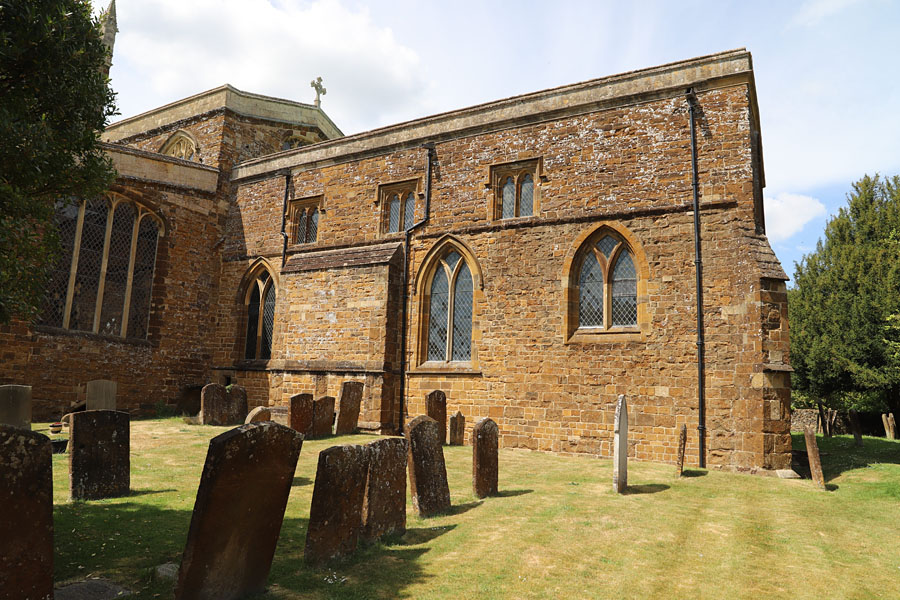
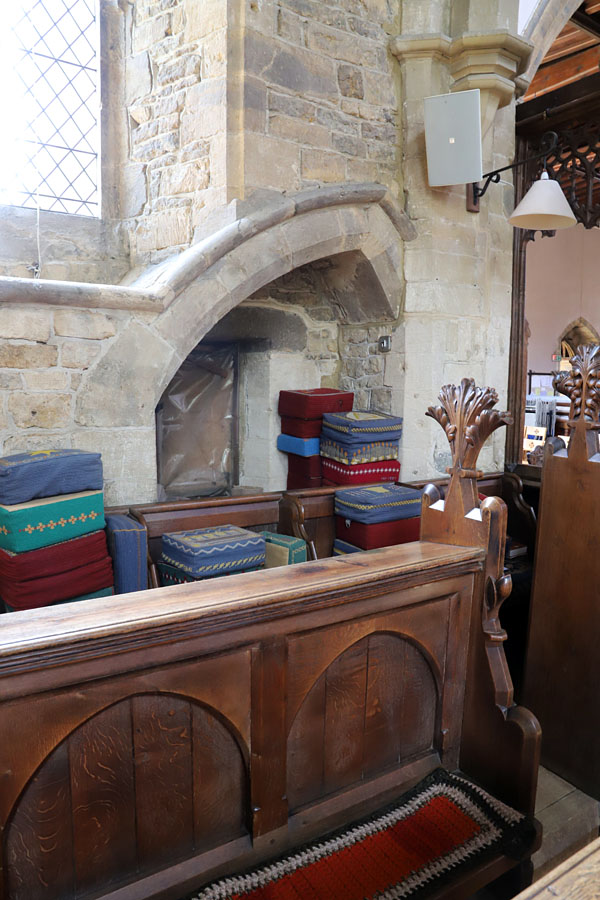
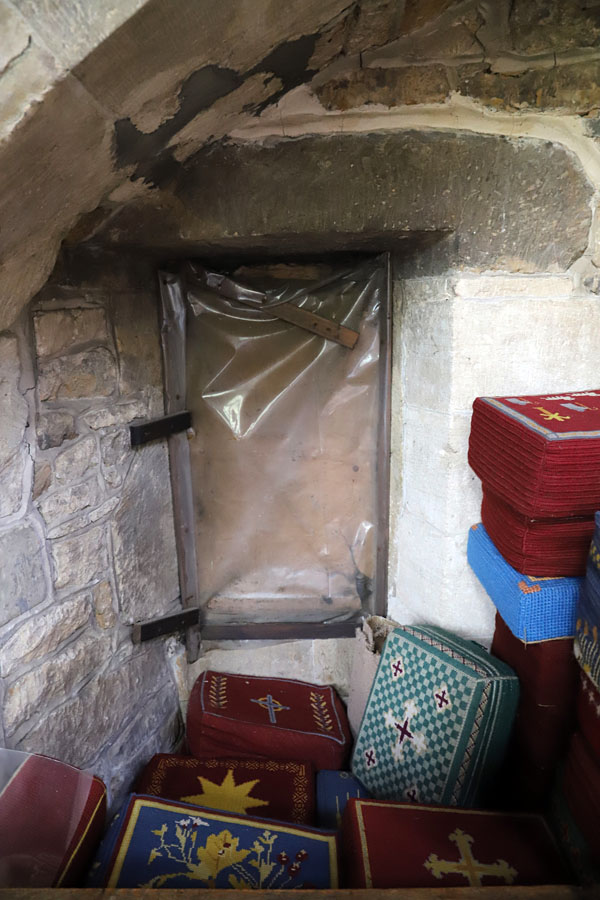
The chancel at St Peter's and St Paul's is c13. It was lengthened in the late c13.1 A clearstorey was added in the c15. On the south wall are three two-light Y-tracery windows. A fourth was removed to extend the wall outwards to accommodate an organ in the c19. The window at the south west corner of the chancel is too high to have been used as a confessional, so a small rectangular aperture was installed below and slightly to the west of it, just underneath a string course. The opening still retains its iron bars and a wooden shutter. Although relatively plain on the outside, internally the window has been recessed under an elaborate pointed arch head which is asymmetric and severely truncated on its west side by the respond of the chancel arch. The arch above the low side window supports the wall above.
St Peter & St Paul;, Deddington, Oxfordshire. General view of the low side window below and slightly to the west of the original c13 Y-tracery window.
St Peter & St Paul;, Deddington, Oxfordshire. External detail. Note iron bars and wooden shutter in situ.
St Peter & St Paul;, Deddington, Oxfordshire. Internal view. The opening is deeply recessed under an asymmetric pointed arch which is curtailed on its west side by the respond of the chancel arch.
St Peter & St Paul;, Deddington, Oxfordshire. Internal detail.
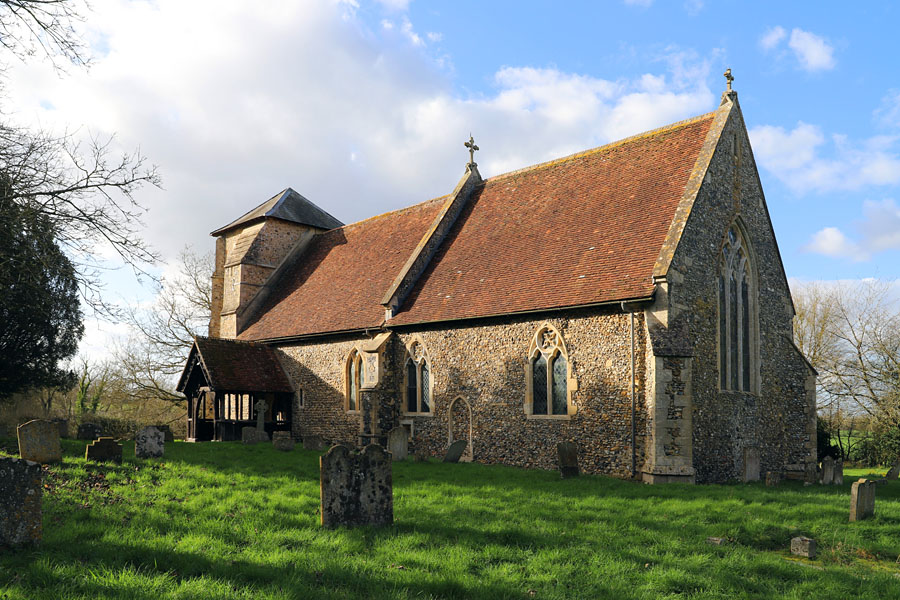
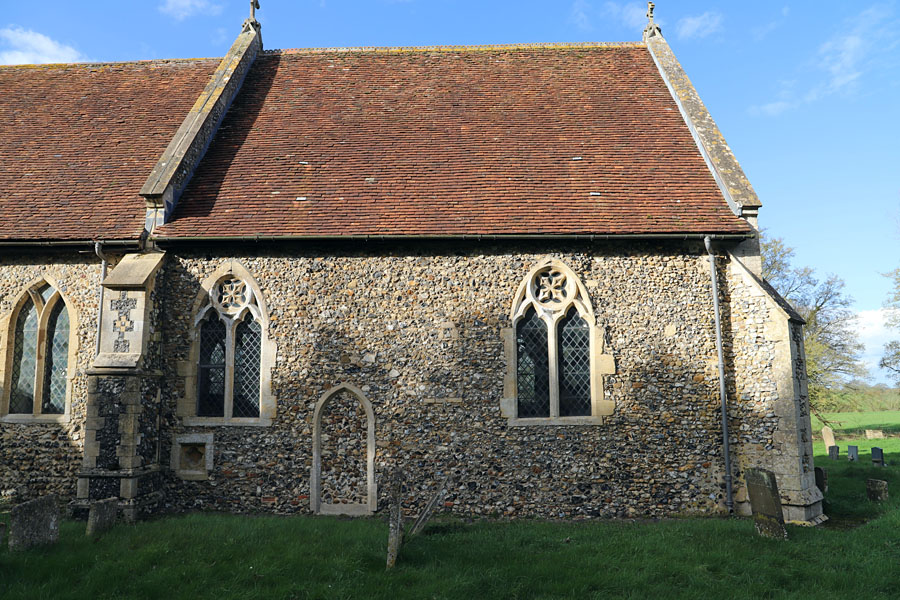
Traces of the Norman church can still be seen in the slit windows on both sides of the nave, and blocked north door. The chancel was built c1300, and has rather unusual tracery in its windows.1, 2 All the chancel windows are too high to have functioned as confessional windows, but the westernmost on both north and south sides are close to the western end. An independent opening was introduced below the south-west window; a pretty quatrefoil carved from a single block of stone which has been set in a shamfered stone surround, much like St Mary's, Essendine, Rutland (see p9). Internally the original window splay on the west side has been lowered, and is only carried across the westernmost light sufficient to accommodated the new opening (see next slides).
Cautley, H. M. Suffolk Churches and their Treasures, 1937, p317.
St Nicholas, Stanningfield, Suffolk. General view of the south chancel. Note the elaborate, and unusual tracery in the windows.
St Nicholas, Stanningfield, Suffolk. External detail.
St Nicholas, Stanningfield, Suffolk. External detail of the low side window.
St Nicholas, Stanningfield, Suffolk. Internal view.
St Nicholas, Stanningfield, Suffolk.
Internal detail. The original splay has been lowered, but only extended across the westernmost light sufficient to accommodate the new opening. The splay has not been lowered enough to create a seat at a suitable height for a confessor, so it is assumed he would have perched himself on a wooden stool (as likely as not did the penitent outside). A slab has been placed above the new opening at the level of the original window's sill. There are no traces of any hinges, and the low opening rebate seems to have been obliterated by plaster.
The list of rectors in the church reveals two changes of incumbency during the period when the Black Death was ravaging England. In 1348 William de Wynkworth was appointed to replace William de Illeya. He lasted a year or so, and was, in turn, replaced by Walter Botelex in 1349. It is possible these changes were caused by the previous incumbent succumbing to the pestilence.
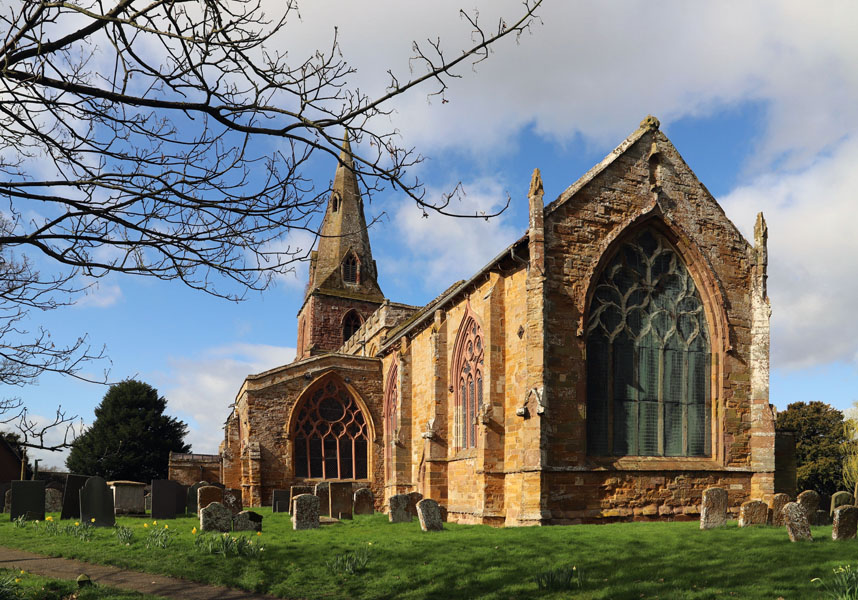
Most of what we see at St Margarets is c14 and c15, though some of its late c12 is still evident (see here). Restored by R. C. Hussey in 1840.1 Further major renovations were carried out in 2011.2 The chancel has four large Dec windows, two on each side, and an even larger east window of similar age. These are all high in the wall, and although the south western window is close to the west end of the chancel it is still too high to function as a confessional window. Here the solution was to install a circular aperture carved from a roughly square block of sandstone, and placed under the earlier window's sill. All trace of the aperture internally is now lost behind high choir stall backs.