
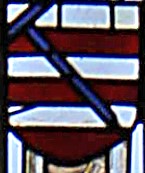
The Coat of Arms of the Priory of Sempringham
in the east window
St Martin’s Church guide says that the coat of arms in position "C" in the tracery is “Gilbert of Sempringham”. However, this is not the whole story. Gilbert of Sempringham founded the Gilbertine Order in 1131. The arms of Gilbert are; Barry of six, argent and gules, over all a cross portate sinister, or.1 However, each priory established for the order has a slight variation on this theme. The shield in the east window is; Barry of six, argent and gules, over all a cross portate dexter, azure.
In Lincolnshire Church Notes Made by Gervase Holles, a coat of arms in Norton Disney church is listed as, Barry of 6 pieces, Arg & G. over all a cross portate in bend B” (note the “B” is assumed to mean blue or azure).2 In a footnote the editor remarks, “The Rectory of Norton Disney was appropriated to the Gilbertine Priory of Sempringham, hence the St Gilbert arms.” There is no doubt that the shield in the east window in St Martin’s is a dedication to St Gilbert, though I have been unable to identify the specific house of the order to which it relates. Of the 26 priories listed in British History Online, two are listed as Robert Holgate having been prior: St Catherine Outside Lincoln (occurs 1529) and Watton, before 1536, and 1539, when he surrendered to Henry VIII at the dissolution). However, Robert Holgate clearly adopted for use within his own arms those of one of the priories belonging to the Gilbertine order. One clue as to the origin of this shield comes from an examination of the arms of Robert Holgate, Bishop of Llandaff and later Archbishop of York 1545 to 1554. The website of the Maltonians (of Malton School, Yorkshire) explains thus:
The family of Holgate to which Robert belonged bore "Or, Three Bull's Heads erased, sable" but Robert was the youngest son of Thomas and there is no evidence that Thomas was the senior member of the family. Robert would therefore be unable to register a right to bear these arms undifferenced.
It is not surprising therefore to find that on the 29th day of June in the year of Our Lord, 1539, being the 31st year of the reign of The Most Illustrious and Victorious King Henry VIII, that William Felow, by the authority and power assigned to him as Norroy, King of Arms and to his office, by terms definitely stated in letters patent, did devise, ordain and assign for the Most Reverend Lord Robert Holgate of Hemsworth in the county of Yorkshire, Doctor of Divinity, Bishop of Llandaff, a shield with insignia of honour, as set out in the following namely :- .
" Or, a bend between two bull's heads, sable, on a chief barry of four argent and
gules a Baculus rectoralis in bend, azure ".3
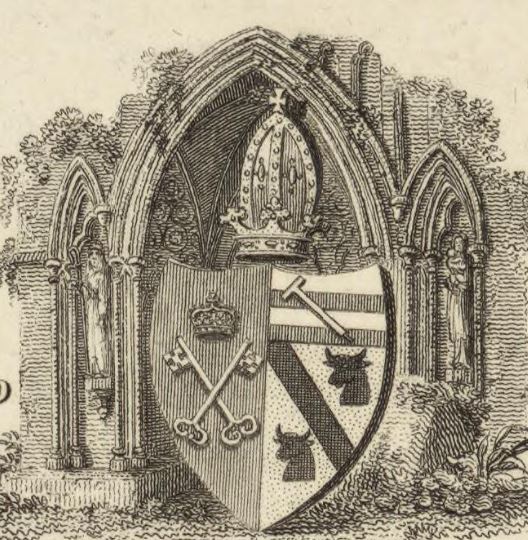
The coat of arms of Robert Holgate when Archbishop of
York incorporating his own, Or, a bend between two bull's
heads, sable, on a chief barry of four argent and gules a
Baculus rectoralis in bend, azure, and the archdiocese
of York. PD image.
At Sempringham, the order used “Barry of six, argent and gules”, but some of the other priories used the bars. For difference, each of the order’s priories would have its own variation of the original arms; e.g. Priory of Alvingham: Arg. 3 bars gu, over all a crosier in bend staff arg. head or, and the Priory of Malton: Arg. 3 bars gu, over all a cross in bend sinister or, but the Alphabetical Dictionary lists the Priory of Sempringham with a barry of 6 and 2 bars. Robert Holgate was educated by the order and in time came to be the Master. The Maltonian website suggests the arms of the Norfolk branch of the Gilbertine Order were; Argent, two bars gules, over all a crutched staff in bend azure.
References: Use your browser's Back button to return to text.
- The website of The Gilbertines
- Lincolnshire Church Notes Made by Gervase Holles AD 1634 to 1642. P245
- Website of the Maltonians