

The East Window contains many coats of arms
remembering the benefactors of St Martins and families
connected with William Cecil, 1st Baron Burghley.
The Coats of Arms: East Window
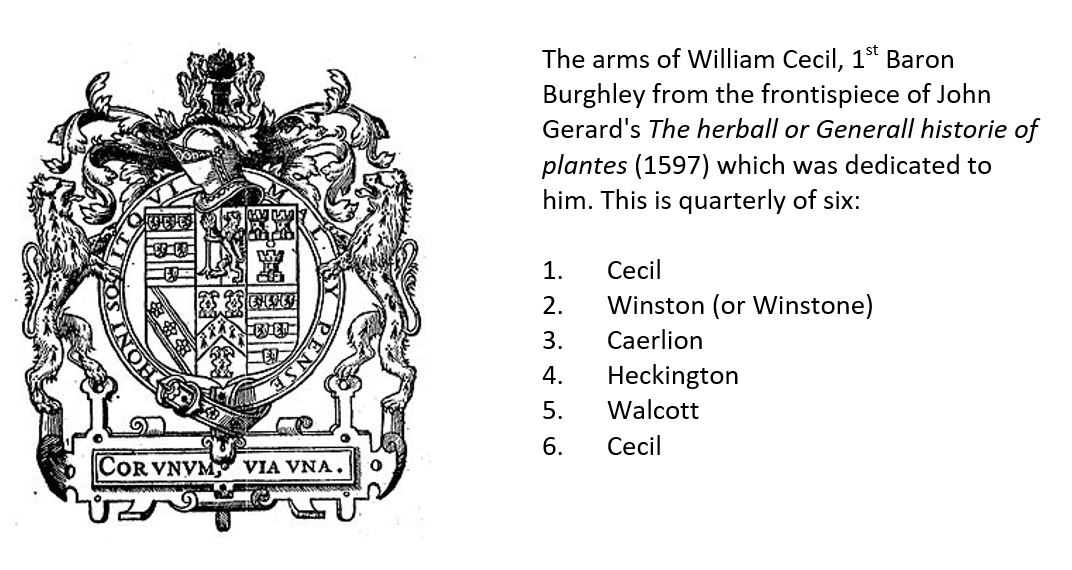
St Martin's is liberally endowed with coats of arms of benefactors and of families antecedent to William Cecil, 1st Baron Burghley (1520 – 1598), Lord High Treasurer to Queen Elizabeth I. William Cecil’s coat of arms incorporated a number of these families, including those of the female line where the woman was an heiress in her own right, and they are all represented in the shields in the east window. For more information click here. Although a great deal of the figurative glass in the east and south aisle windows came from Tattershall, it is likely that many of the coats of arms are original to building of the church we see today, dating from the 15th century.
As has been mentioned, the short church guide jumbled up the arrangement of the shields, and there are some errors, which makes identification for the visitor rather tricky.1 It is unsurprising that some errors have been made in assigning names to the shields. Identifying coats of arms is a notoriously difficult pastime. The difficulty is compounded by the passage of time and the inevitability of weathering, damage, and lack of (or overzealous) cleaning, all resulting in the colours fading and/or darkening. Notwithstanding all the above insults to the glass there is also human error or a misplaced assumption, which without proper scrutiny or peer review becomes engraved as fact. The internet (and a few well-placed search criteria) has made life significantly easier. I am indebted to the likes of Google Books, The Internet Archive, and Wikipedia, along with more specialised websites such as the Corpus Vitrearum Medii Aevi (CVMA.ac.uk). Thankfully, a good deal of the shields are embellished with a name tag, making identification a lot easier, though powerful lenses are required to make them out.

East Window Tracery:
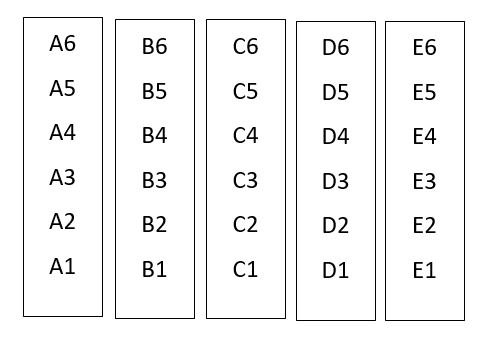
In an attempt at simplifying the identification of the subject matter in the tracery the position of letters on the diagram below, correspond to the following descriptions.
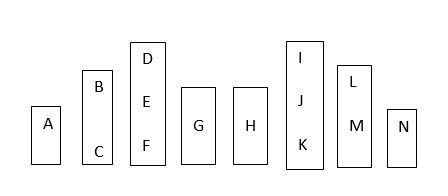
Although the great majority of the shields have been identified, there is still some doubt over a few, and questions as to why they should have been included. Some speculation is therefore necessary until further corroborative references come to hand. The inclusion of coats of arms of families connected by marriage to William Cecil, 1st baron Burghley (1521–1598), and his father Sir Richard Cecil (1495 - 1553) does suggest that the glass in the tracery was made for St Martin’s specifically, and was installed during the 16th century, unlike the coats of arms of Archbishops of York and Bishops of Lincoln which might suggest late 15th century (see below).
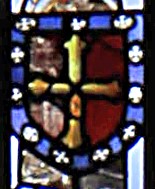
| A: | Gules, a cross patonce or, within a bordure azure, charged with twelve crosslets argent (The CG suggests-“possibly”- Latimer). GM article does not elaborate name. Latimer is not entirely correct as there is the issue of the charged bordure so it will be an offshoot of the Latimer family or a minor (male) sibling. |
 |
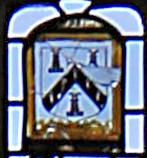
| B | Argent, a chevron between 3 chess rooks ermine (Wolcott, Wollcott, Walcott or Wallcott) Lady Alice Walcott, who married Sir William Heckington of Bourne, was William Cecil's grandmother, and mother of Jane Heckington, William's mother. |
 |
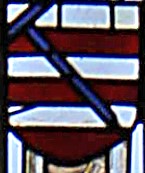
| C | Barry of 6, argent and gules, overall a cross patent azure (for the Priory of Sempringham). For more on the history and provenance of this coat of arms click here. |
 |
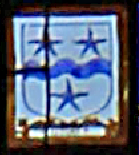
| D | Argent, a fess wavy between 3 estoiles azure (Gylby) I have not been able to confirm a connection between Gylby (or Gilby) and St Martin’s |
 |
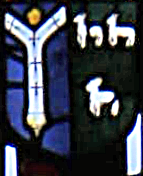
| E | Az, a pastoral staff in pale or, heightened with a cross pattée arg, and surmounted of a pale of the last, charged with 4 crosses formée sable (York, ancient). Impaling vert, 3 bucks trippant argent, attired (for Scott AKA Rotheram). These are the arms of Thomas Rotheram, Archbishop of York 1480-1500. It is thought that Rotheram, along with Russell, Bishop of Lincoln, and Shirwood, Bishop of Durham were the benefactors of St Martin’s rebuild started about 1482 and all three are commemorated in the east window. |
 |
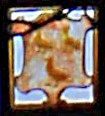
| F | Gules 3 Martletts proper. Notes: The church guide says “Ayscough”. However, Ayscough arms are at position K in my diagram. GM does not elaborate name. As can be seen from the picture right, the glass is badly weathered and colouring may well have altered over the years making identification difficult. |
 |
| G & H | Annunciation scene, BVM to right and Archangel Gabriel to the left, with two small heads above each character. Inscription reads, “gra plena and ancilla dni” | 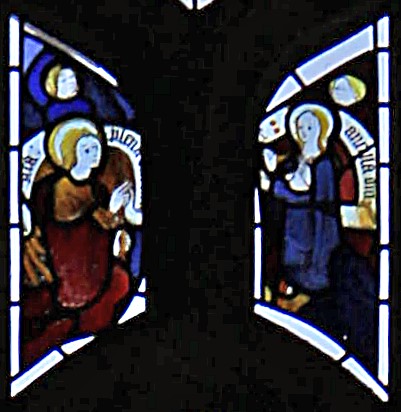 |
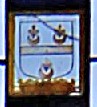
| I | Argent, a fesse, between 3 crescents jessant for Ogell. Notes: Church guide says “unknown”, but then lists Ogell in position L on my diagram. GM confirms Ogell is the correct name. The name tag below the shield confirms Ogell. |
 |
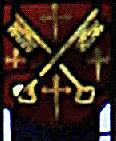
| J | Gules, 2 keys in saltire or, between 4 crosslets fitchée of the last (Abbey of Peterborough). St Martin’s was once in Northamptonshire and therefore under the See of Peterborough. |
 |
| K | Sable,a fess or, between three assess trippant ermine (Ayscough) Notes: Church guide puts Parnell in position K on my diagram. Ayscough is shown in position F. This is completely wrong. GM is correct, and the name tag below the shield confirms this. |
 |
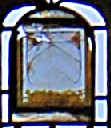
| L | Gules, two chevrons argent for Parnell. Notes: Church guide says Ogell in this position which is incorrect. As with the arms in position F, the glass is much weathered and difficult to identify. GM says arms of Parnell, and although the name tag below the shield is badly disfigured the "P" and "A" can still just be made out. |
 |
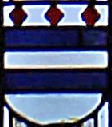
| M | Azure, 2 bars argent, in chief three lozenges gules. Both the CG and the GM article state that these are the arms of Richard Flemming, Bishop of Lincoln from 1421 to 1431.2 |
 |
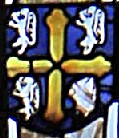
| N | Azure, a cross flory or, between four lions rampant (prior of Durham). The CG says this is the arms of the monastery of St Cuthbert, Durham, or the abbey of Bardney Lincolnshire. |
 |
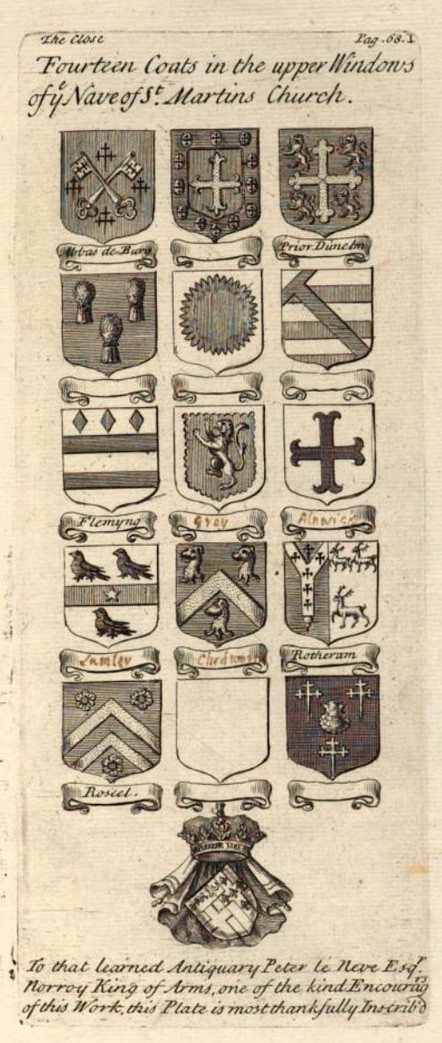
In 1727 Peck recorded arms of three other Bishops of Lincoln, those of Grey, Alnwick and Lumley, which have now disappeared (illustration right). The CG begs to suggest that this would have completed a sequence of Lincoln bishops from Fleming (1420-31) to Russell (1480-94). Although plausible, the arms of Thomas Rotheram are those when he was Archbishop of York, not Bishop of Lincoln, but it does not explain the inclusion of other coats of arms which are not those of Bishops of Lincoln. However, the inclusion of Rotheram’s arms confirms that the glass is pre 1500.
Referring to Fig 7, and reading top to bottom, left to right, the arms are:
- Abbas de Burgh (i.e Abbot of Peterborough).
- Untitled, but possibly Latimer - see "A" above.
- Prior Dunelm (i.e. Priory of Durham). Dunelm is the latinised name for Durham.
- Untiltled
- Untitled
- Untitled, but identified above for the Priory of Semperingham (Robert Holgate)
- Richard Fleming, Bishop of Lincoln 1420 - 1431. The arms are missing the five pointed star in the middle of the shield.
- William Grey, Bishop of Lincoln 1431 - 1436
- William Alnwick (or Alnewick), Bishop of Lincoln, 1437 - 1450.
- Marmaduke Lumley, Bishop of Lincoln, 1450
- John Chadworth, Bishop of Lincoln, 1452 - 1472.
- Thomas Rotherham (or Rotheram), Bishop of Lincoln, 1472 - 1480. As mentioned above these are the arms of Rotherham when he was Archbishop of York (1480 - 1500).
- John Russell (or Rossel) Bishop of Lincoln 1480 - 1494
- Blank shield.
- Untitled..
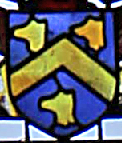
| Left | Azure, a chevron between three greyhounds heads erased or. The CG states this as the arms of Chedworth after John Chedworth (or Chadworth), Bishop of Lincoln 1452 – 1471. The GM does not proffer a name. |
 |
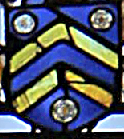
| Right | Azure, two chevronels or, between three roses argent, seeded or; for John Russell, Bishop of Lincoln 1480 – 1494. |
 |
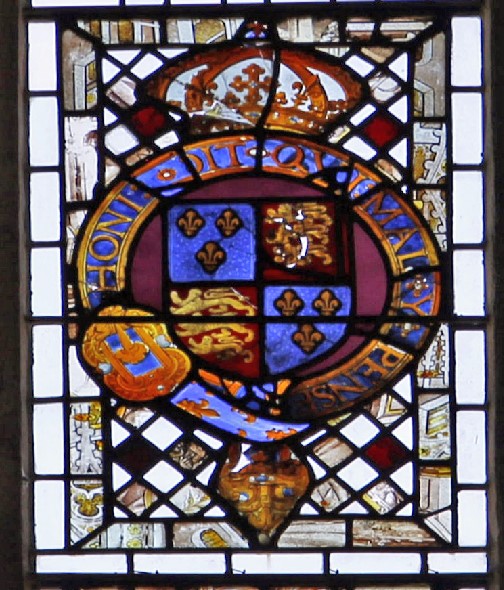
| C6 | Arms of Queen Elizabeth I in garter. |
 |
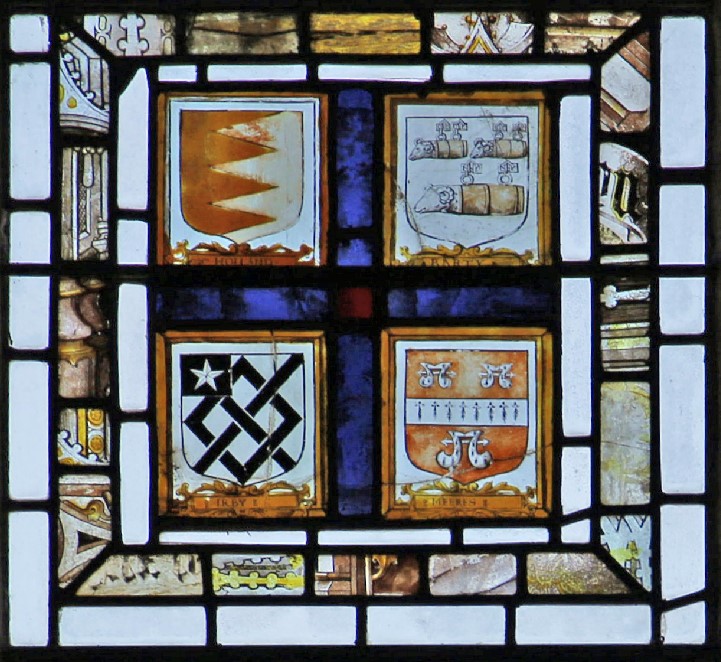
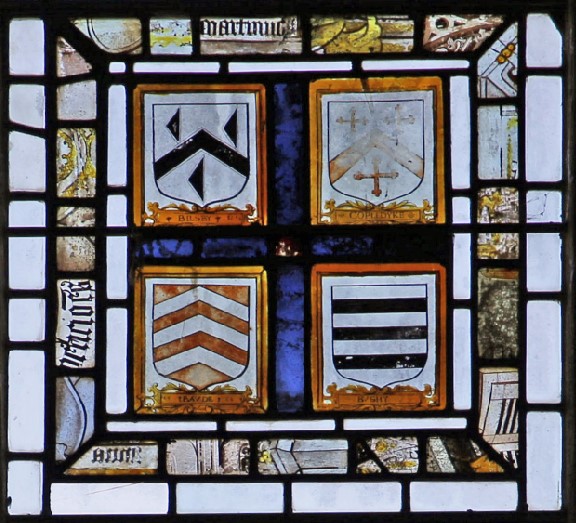
| A2 | Four coats of arms: |
 |
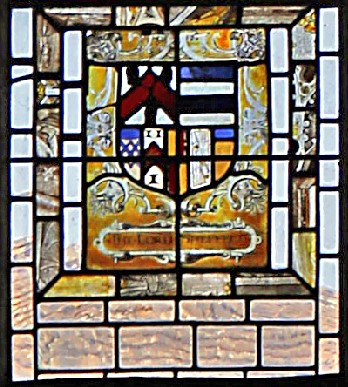
| A1 | A coat of arms: The Lord Sheffiled
|
 |
| E2 | Four coats of arms: In this panel, Peckitt has incorporated fragments of glass from other windows, possibly the original windows in St Martins. Bottom left can be seen the word “Anne”, and top what appears to say “Martinus”. |
 |
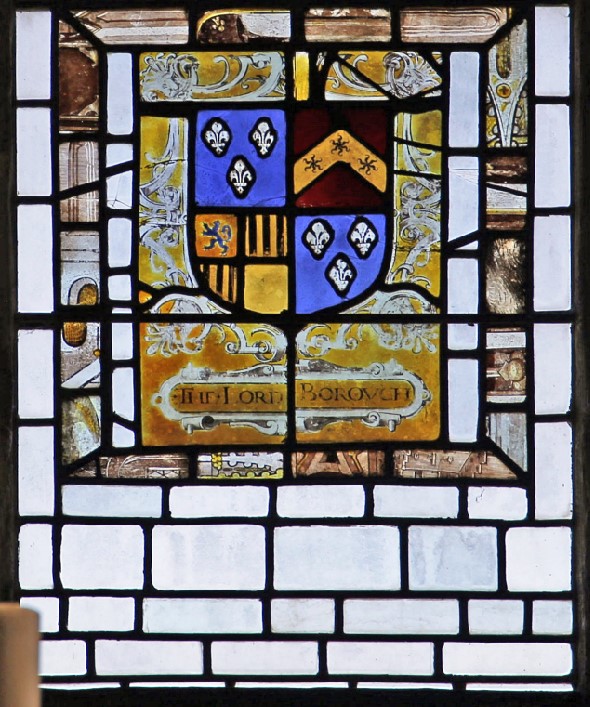
| E1 | Quarterley of four – The Lord Borough: 1. Azure, three fleur de lys sable – Borough. 2. Gules, a chevron or, charged with three stars sable – Cobham. 3. Quarterley: 1 and 4, or, a lion rampant azure, armed gules – Percy; 2 & 3, argent, three pallets sable – Comyn. |
 |
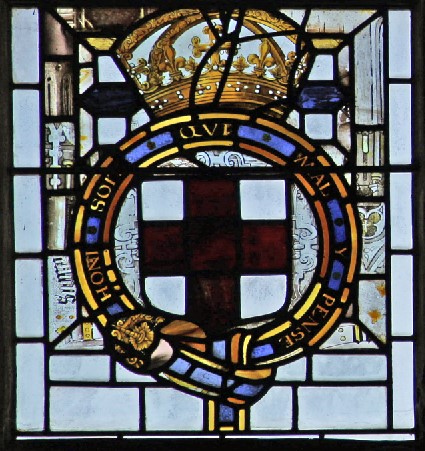
| B1 | Argent, a cross gules all within a garter – St. George |
 |
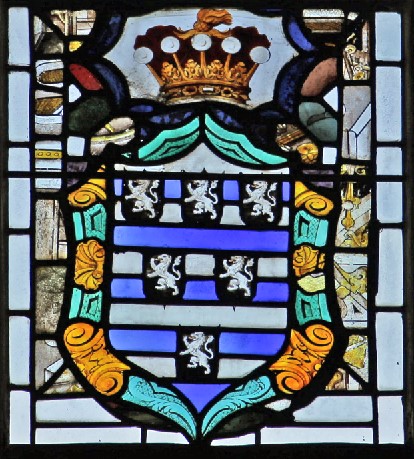
| C1 | Barry of nine, argent and azure, over all six escutcheons, 3, 2 & 1 sable, each charged with a lion rampant of the first – Cecil. These arms may have been made by William Peckitt in 1759. |
 |
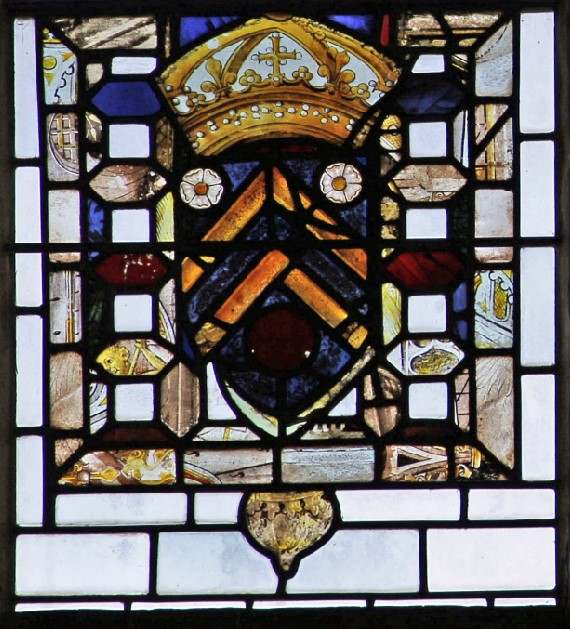
| D1 | Azure, two chevronels or, between three roses argent, seeded or; for John Russell, Bishop of Lincoln 1480 – 1494. John Russell was a major benefactor to the church when it was rebuilt between 1480 and 1485. |
 |
References: Use your browser's Back button to return to text.
- For assistance with the identification of the shields in St Martin’s I have used as a good reference guide, the article in The Gentleman’s Magazine (GM) of March 1862, available on Google Books. Also available at Google Books is the excellent book, An Alphabetical Dictionary of Coats of Arms of the Families of Britain and Ireland.
- See An Alphabetical Dictionary of Coats of Arms Belonging to Families in Great Britain & Ireland. Papworth, John W. 1864; P967. Google Books. Entry for Richard Fleming, Bishop of Lincoln & founder of Lincoln College, Oxford; Barry of six arg. And az. In chief three lozenges gu. However, a portrait of Fleming in the National Portrait Gallery includes a coat of arms with the addition of a red star in the central bar.
- Harrod, W. The Antiquities of Stamford & St Martin’s from the Annals of the Rev. Francis Peck 1727. Available at Google Books.